SEO (Search Engine Optimization) has changed significantly as the way people search for information continues to evolve. Search is no longer limited to typing keywords into a search engine and choosing from a list of blue links.
Today, people can discover information through traditional search results, AI Overviews, conversational AI platforms, and other AI-powered search experiences. This has expanded the role of SEO from simply improving rankings to helping businesses become discoverable wherever their audiences search.
So, what does SEO in digital marketing involve in 2026? And how should businesses approach it in a search environment increasingly shaped by AI?
The New Era of SEO: From Search Engines to AI-Powered Search in 2026
Three major changes are shaping search in 2026.
- AI is becoming part of the search experience: Google uses AI Overviews and other generative features to provide summaries for eligible searches, with links to supporting sources. Users can sometimes get an answer without visiting a website, although websites remain important when users need more detailed information, expert perspectives, products, or services.
- AI platforms are becoming another discovery channel: Platforms such as ChatGPT, Claude, Perplexity, and Gemini allow users to ask questions in conversational language, refine their queries, compare options, and explore topics through follow-up questions. Depending on the platform and query, responses may include links or citations to web sources.
- Brand discovery can happen without a traditional search click: A business can now be discovered through an AI-generated answer, a cited source, a brand mention, or a conventional search result. This means visibility is no longer limited to where a webpage ranks on a traditional results page.
These developments have led to terms such as Generative Engine Optimization (GEO) and Large Language Model Optimization (LLMO). These are commonly used to describe efforts to improve visibility across AI-powered search and answer experiences. They should be viewed as extensions of SEO rather than replacements for its established foundations.
Is Traditional SEO Still Relevant?
Yes.
Google’s guidance for generative AI search makes this clear: its AI search experiences continue to rely on the same fundamental SEO principles that support traditional Search. Google recommends focusing on technically accessible websites and unique, helpful, people-first content rather than searching special “AI ranking hacks.”
The fundamentals, therefore, remain important:
- Create useful, original content.
- Make important pages accessible to search engines.
- Build a clear website structure.
- Demonstrate expertise and credibility.
- Understand what users are looking for.
- Provide a good experience across devices.
AI is changing how information is discovered and presented, but it does not eliminate the need for strong SEO foundations.
What Is SEO in Digital Marketing?
SEO (Search Engine Optimization) is the process of improving a website so its pages can become more visible in relevant unpaid search results and reach people looking for the information, products, or services a business provides.
In digital marketing, SEO brings together several activities, including:
- Keyword and search intent research
- Content creation and optimization
- Technical SEO
- Internal linking
- Website structure improvements
- Digital PR and link acquisition
- Performance and user experience improvements
- Measuring organic visibility and conversions
The objective is not simply to attract more visitors. Effective SEO aims to attract relevant visitors who are more likely to engage with the business and take meaningful actions.
Unlike paid advertising, businesses do not pay a search engine for every organic click. However, SEO requires ongoing investment in content, technical improvements, authority, and measurement, and results are not guaranteed.
How Do Search Engines and AI Platforms Process Content?
Search engines and AI platforms use different systems to discover, retrieve, evaluate, and present information. The exact process varies by platform, but it can be understood through three broad stages.
1. Finding Your Pages
Search engines use automated crawlers to discover webpages. They can follow links between pages and use signals such as XML sitemaps to discover important URLs.
A technically sound website can make this process easier through:
- Clear internal linking
- XML sitemaps
- Logical website architecture
- Appropriate robots.txt directives
- Accessible page content
AI platforms can also retrieve information from the web, but their systems differ. Some use web search or retrieval systems to find current sources, while others may rely on information already available to them.
For example, OpenAI distinguishes OAI-SearchBot, which is used to surface websites in ChatGPT search, from GPTBot, which is associated with crawling content that may be used for training its foundation models.
2. Understanding Your Content
Once content is discovered, search systems analyze it to understand what each page is about and how it relates to other information.
This goes beyond matching exact keywords.
Search systems can interpret:
- Topics and subtopics
- Entities
- Relationships between concepts
- Context
- Search intent
- Content structure
- Links between related pages
Some AI retrieval systems also use vector embeddings to represent the meaning of content as numerical data. These representations can help identify information that is semantically related to a query even when the wording differs.
This is why simply repeating a keyword is no longer an effective content strategy. The page needs to explain the topic clearly and cover the information users actually need.
3. Ranking, Answer Generation, and Citation
Traditional search engines evaluate webpages using many signals before determining which results to show and in what order.
AI-powered platforms may retrieve information from multiple sources and use that information to generate an answer. Depending on the platform and query, the response may include links or citations to the sources used.
These are related but different outcomes:
- A webpage can rank well in Google without being cited in an AI response.
- A source can be referenced by an AI platform without holding a top organic position for every related query.
- A business may appear in both traditional search and AI-generated answers.
Therefore, modern SEO should consider search visibility as a broader discovery ecosystem, rather than treating rankings as the only measure of success.
How Search Intent Influences SEO in 2026
Search intent is the reason behind a user’s query. Understanding it helps businesses decide what information to provide and which content format is most appropriate.
| SEARCH INTENT | WHAT THE USER WANTS | EXAMPLE SEARCH | SUITABLE CONTENT |
| Informational | Learn something or find an answer | How does SEO work ? | Guides, Articles, FAQ’s |
| Navigational | Reach a specific website, brand or page | Semrush login | Brand Pages, Login Pages, Clear Navigation |
| Commercial | Compare options before making a decision | Best SEO Agencies | Comparison pages, reviews, case studies |
| Transactional | Take an action or make a purchase | Hire an SEO Agency | Services pages, Product pages, Enquiry forms |
The same intent can appear differently across traditional search engines and AI platforms.
For example, a user might search Google for “best enterprise SEO tools”, while asking an AI platform to “compare enterprise SEO tools based on features, reporting, and AI visibility.”
The wording is different, but the underlying intent is similar.For businesses, this means content should be created around the need behind the query, rather than focusing only on exact keyword variations.
The 4 Pillars of SEO in Digital Marketing
Modern SEO brings together four closely connected areas:
- On-Page and Semantic SEO
- Technical SEO and AI Accessibility
- Off-Page SEO and Brand Authority
- E-E-A-T and Entity Trust
These pillars work together to help search systems discover, understand, evaluate, and present a business’s content.
1. On-Page and Semantic SEO
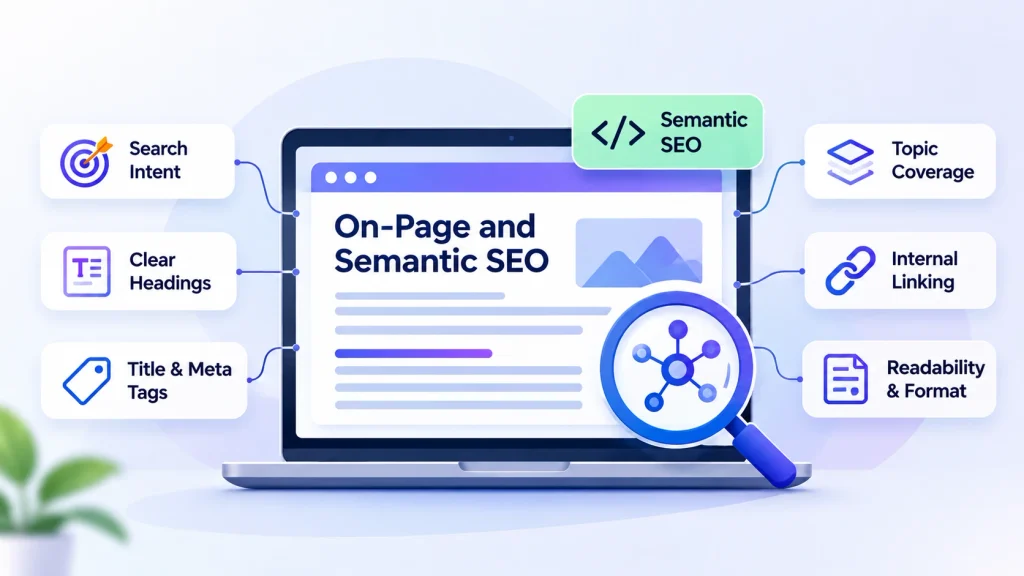
On-page SEO focuses on improving individual webpages so users and search engines can understand their purpose and content.
Important areas include:
- Search intent: Create content that directly addresses what the user is trying to accomplish.
- Clear headings: Use descriptive headings to organize information logically.
- Title tags and meta descriptions: Write clear page titles and descriptions that accurately represent the page.
- Relevant terminology: Use natural language and related concepts instead of repeating the same keyword.
- Content depth: Cover the important questions and subtopics users need to understand the subject.
- Internal linking: Connect related pages to help users and search engines discover additional relevant content.
- Useful formatting: Use lists, tables, examples, and short sections when they improve readability.
Semantic SEO is particularly important because search systems increasingly understand relationships between topics and concepts rather than relying only on exact keyword matches.The goal is not to write for an algorithm. It is to make the subject clear, useful, and complete for the person reading it.
2. Technical SEO and AI Accessibility
Technical SEO provides the foundation that allows search systems to access and understand a website.
Key areas include:
- Crawlability: Make sure important pages can be accessed by relevant crawlers.
- Website architecture: Organize content into a logical structure.
- Internal links: Help users and search engines move between related pages.
- XML sitemaps: Provide search engines with a list of important URLs.
- Structured data: Use relevant Schema.org markup to provide additional context about webpages and entities.
- Page experience: Monitor loading performance, responsiveness, and visual stability.
- Mobile usability: Ensure content, navigation, and interactive elements work properly on mobile devices.
- Indexing controls: Monitor canonical tags, redirects, noindex directives, and other signals that affect how pages are processed.
Structured data can support eligibility for certain rich results, but it is not a special requirement for appearing in Google’s generative AI features. Google specifically states that there is no special schema markup required for generative AI search.
You may also come across llms.txt, a proposed file intended to provide AI systems with a curated guide to website content. Google Search does not use it, and Google states that maintaining it will neither improve nor harm visibility or rankings in Google Search.
For this reason, businesses should treat llms.txt as an optional emerging convention rather than a core SEO requirement.
3. Off-Page SEO and Brand Authority
Off-page SEO focuses on signals and activities that take place beyond a website’s own pages.
One of its most established elements is link acquisition.
Relevant links from credible websites can support a site’s authority and help search engines understand its relationship with an industry or topic. The focus should be on quality and relevance rather than the number of links acquired.
Other off-page activities include:
- Creating useful resources that naturally attract references
- Building relationships with relevant publishers
- Contributing expert insights to industry publications
- Participating meaningfully in relevant communities
- Earning coverage through digital PR
- Maintaining consistent business information across relevant profiles and directories
- Building genuine brand awareness across the wider web.
Brand mentions can contribute to awareness and help people understand a business, but they should not be presented as a guaranteed ranking or AI citation signal.
Google’s own guidance also cautions against pursuing artificial mentions simply to influence generative AI visibility.
The priority should therefore be earning genuine recognition, not manufacturing mentions.
4. E-E-A-T and Entity Trust
E-E-A-T stands for:
- Experience
- Expertise
- Authoritativeness
- Trustworthiness
Google uses these concepts in its Search Quality Rater Guidelines to help evaluators assess the quality and reliability of content. E-E-A-T is not a single ranking score.
Businesses can demonstrate these qualities by:
- Experience: Share first-hand knowledge, practical insights, original research, testing, and real examples.
- Expertise: Make sure content is accurate and created or reviewed by people who understand the subject.
- Authoritativeness: Build recognition through credible industry contributions, references, and professional coverage.
- Trustworthiness: Provide accurate information, transparent business details, clear contact information, and reliable content.
Entity understanding is another important part of modern search.
Search systems need to understand who or what a business is, what it offers, and how it relates to other entities and topics.
Consistent information across your website and relevant external sources can help create a clearer representation of the business.
How the Four Pillars Work Together
The four pillars should not be treated as separate SEO activities.
Consider an ecommerce business selling running shoes.
- On-page SEO: Create useful product and category pages that explain product features, use cases, sizing, and related questions.
- Technical SEO: Ensure important pages are crawlable, mobile-friendly, fast, properly linked, and correctly indexed.
- Off-page SEO: Earn relevant links, reviews, editorial coverage, and industry references.
- E-E-A-T and trust: Provide accurate product information, genuine reviews, clear business details, expert guidance, and evidence that supports important claims.
Each pillar supports the others.
Useful content has limited value if search engines cannot access it. A technically strong website may struggle to perform if its content does not meet user needs. Strong content and technical foundations become more valuable when the business also has a credible reputation.
How Do You Measure SEO Performance in 2026?
Rankings remain useful, but they are only one part of SEO measurement.
Businesses should evaluate SEO through metrics that connect visibility with actual business outcomes.
Rankings
Track where important pages appear for relevant search queries and how visibility changes over time.
Organic Traffic
Measure users and sessions arriving through organic search. Look beyond total traffic and examine which pages, topics, and queries are attracting relevant visitors.
Search Visibility
Monitor impressions, clicks, click-through rates, and the queries generating visibility.
Conversions
Track actions that matter to the business, such as:
- Form submissions
- Phone calls
- Purchases
- Quote requests
- Bookings
- Brochure downloads
- Sign-ups
AI-Powered Visibility
As AI search develops, businesses can also monitor whether their brand or content appears in relevant AI-generated responses where measurement tools or platform data make this possible.
However, AI citations should be treated as one part of a broader visibility strategy, not as a replacement for organic search performance.
The most important question remains:
Is SEO helping the business reach the right audience and generate meaningful results?
A page can rank well and still produce little business value if it attracts the wrong audience or fails to guide visitors toward the next step.
Conclusion: Building a Future-Ready SEO Strategy
SEO in 2026 is no longer limited to improving rankings on traditional search engines. It is about making a business discoverable wherever people search, research, compare, and make decisions.
AI-powered search is changing how information is retrieved and presented, but the foundations of effective SEO remain strong. Businesses still need technically accessible websites, useful and original content, clear search intent alignment, credible authority, and trustworthy information.
The opportunity is to combine these foundations with an understanding of emerging AI-powered search experiences. Businesses that focus on being genuinely useful, technically accessible, and credible are better positioned to build long-term visibility across both traditional search and AI-powered discovery.
Ultimately, SEO in digital marketing is not just about getting more traffic. It is about being found by the right audience, earning their trust, and helping them take the next step toward your business.
Ready to Be Found Wherever People Search?
Global Media Insight can help.
Our SEO services combine traditional SEO with strategies for the evolving AI search landscape. From keyword research and technical SEO to content optimization, authority building, and AI search visibility, we help businesses strengthen their online presence and connect with the audiences that matter.