The United Arab Emirates population in 2026 continues to grow steadily as the country strengthens its position as a global centre for business, trade and innovation.
Professionals, entrepreneurs and investors from around the world choose the UAE for its economic opportunities, advanced infrastructure and high quality of life, contributing to a diverse and rapidly expanding population.
Understanding UAE population statistics offers more than simple demographic insight.
These numbers reveal how the country is evolving, which nationalities form the largest communities, where residents are concentrated, and how the workforce is changing over time.
In the sections ahead, we break down the latest UAE population statistics for 2026, including population growth trends, expatriate demographics and key insights into the country’s changing demographic landscape.
Explore the data to understand how these shifts continue to shape the UAE’s development and future growth.
UAE Population 2026 (Key Statistics)
-
As of March 2026, the population of the United Arab Emirates stands at 11.57 million, based on data collected by the GMI research team. This figure includes both UAE nationals and expatriates living across the seven emirates.
-
According to the research conducted by the GMI Team, Dubai’s population reached 4.47 Million in 2026.
-
The latest available data from the statistics centre – Abu Dhabi (SCAD) shows that Abu Dhabi’s population reached 4.14 Million in 2024.
-
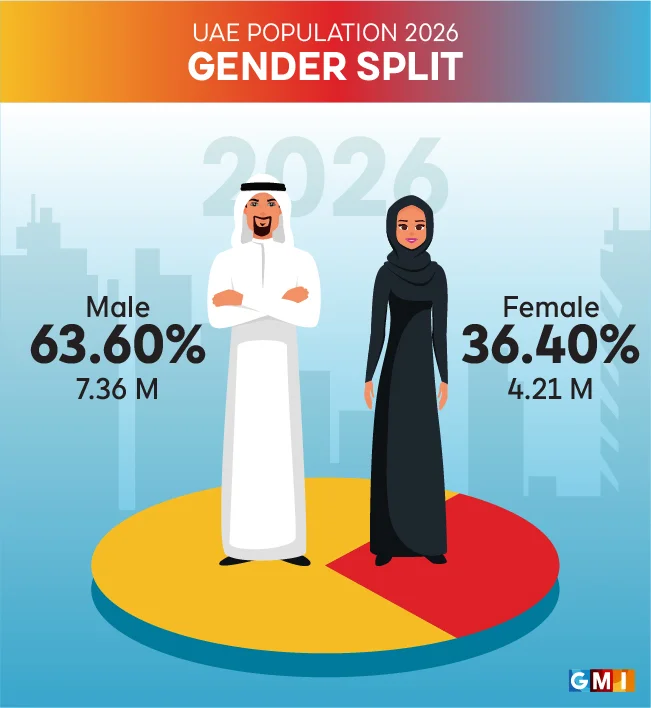
The total male population in the UAE in 2026 is approximately 7.36 million
-
The total female population in the UAE in 2026 is 4.21 million
-
According to research by the GMI Team, the total expat population in the UAE in 2026 is 10.24 million, while the number of Emirati citizens is 1.33 million. This mix of people is important for the country’s growth and culture.
-
In 2026, the Indian community in the UAE is estimated to number nearly 4.39 million, accounting for approximately 37.96% of the country’s total population. They represent the largest expatriate group and contribute significantly to the UAE’s economy and daily life.
-
The largest age bracket in the UAE’s population falls between 25 and 54 years, making up 7.45 million people.
-
In 2026, the UAE’s urban population reached 10.22 million, with 1.35 million people living in rural areas. This highlights the country’s strong focus on city life and development.
-
According to Digital 2026 report by DataReportal, the median age of the population in the UAE is 31.6. This figure offers a glimpse into the country’s demographic profile, suggesting a relatively young and dynamic populace.
-
As of 2026, the UAE has an estimated population density of around 138 people per square kilometre (359 people per square mile).
UAE Population 2026 (Infographics)

Demographic Insights of UAE in 2026
Our 2026 data analysis shows a clear gender distribution across the UAE’s population.
|
Gender |
Population |
Percentage |
|
Male |
7.36 Million |
63.60% |
|
Female |
4.21 Million |
36.40% |
In 2026, males account for around 63.6% of the UAE’s population, while females represent about 36.4%.
This difference reflects the country’s long-standing demographic pattern shaped largely by labour migration, where many male workers move to the UAE for employment opportunities.
The gender distribution is generally more balanced among children and younger age groups.
However, the working-age population shows a higher proportion of males due to the continued inflow of migrant workers.
Despite the imbalance, women play an increasingly important role in the UAE’s economy and society. Government initiatives promoting female leadership, equal pay and board representation have helped strengthen women’s participation across business, government and education.
Overall, these figures highlight how migration and workforce demand continue to influence the UAE’s demographic structure.
Age Distribution of the UAE Population in 2026
|
Age Group |
Percentage |
Population (Million) |
|
0–14 years |
15.91% |
1.84 |
|
15–24 years |
12.53% |
1.45 |
|
25–54 years |
64.39% |
7.45 |
|
55–64 years |
5.34% |
0.62 |
|
65+ years |
1.83% |
0.21 |
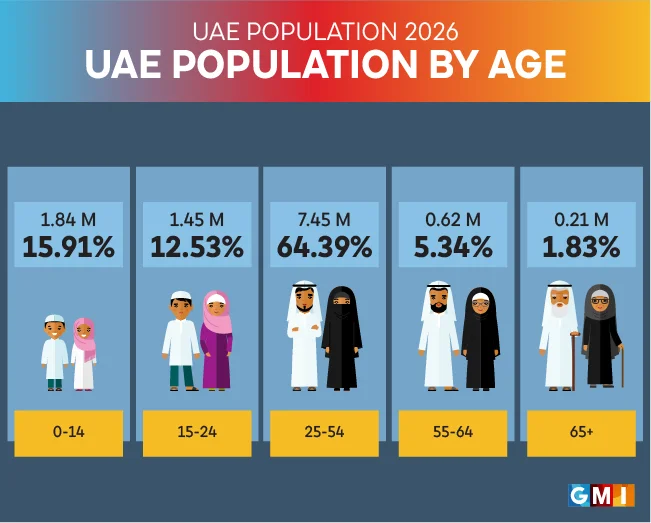
The age distribution of the UAE’s population in 2026 shows a country largely made up of people in their prime working years.
This demographic structure reflects the UAE’s role as a major destination for global talent and employment.
People aged 25–54 years form the largest segment, accounting for 64.39% of the population, or around 7.45 million residents.
This group represents the core of the UAE’s workforce, supporting key industries such as construction, technology, healthcare, trade and services.
The large share of this age group is closely linked to the inflow of expatriate professionals and workers.
Children aged 0–14 years make up about 15.91% of the population, or roughly 1.84 million people.
This indicates a stable presence of families living and working in the UAE.
The 15–24 years age group accounts for around 12.53%, or about 1.45 million individuals.
Many people in this category are students or early-career professionals entering the labour market.
Older age groups remain relatively small.
Residents aged 55–64 years represent about 5.34% (0.62 million), while those aged 65 and above account for around 1.83% (0.21 million).
This reflects the UAE’s demographic pattern, where most residents move to the country primarily for employment rather than retirement.
Overall, the UAE’s population structure is strongly centred around the working-age population, which supports economic activity, labour demand and continued development across multiple sectors.
UAE Population by Gender in 2026
|
Age Group |
Men (in Million) |
Women (in Million) |
|
0–14 years |
0.92 |
0.92 |
|
15–24 years |
0.87 |
0.58 |
|
25–54 years |
5.07 |
2.38 |
|
55–64 years |
0.39 |
0.23 |
|
65 years and over |
0.12 |
0.09 |
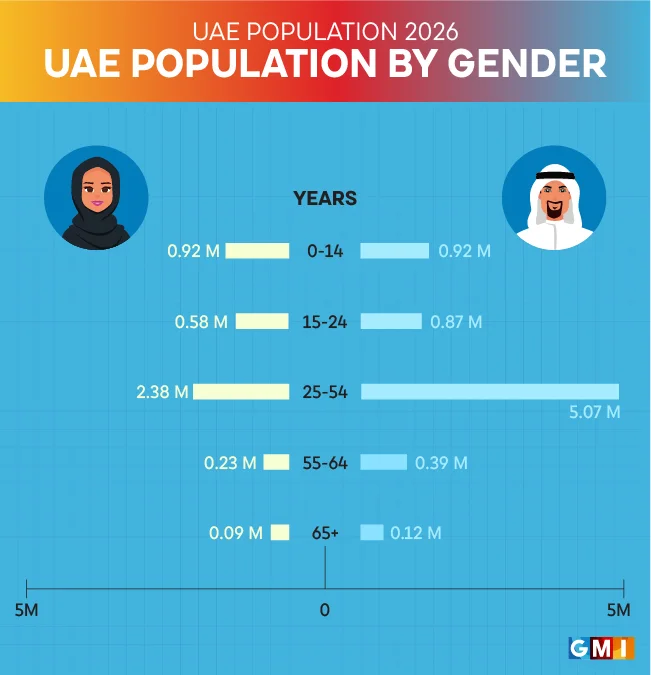
The gender distribution across age groups in the UAE highlights how migration patterns influence the country’s demographic structure.
In the 0–14 years category, boys and girls are almost equal, with 0.92 million each. This balanced ratio reflects typical birth patterns and the presence of family households across the country.
The difference becomes visible in the 15–24 years group. There are about 0.87 million young men compared to 0.58 million young women.
This shift partly reflects migration, as many young men move to the UAE for education, training and early career opportunities.
The gap is most pronounced in the 25–54 years age group. Around 5.07 million men compared with 2.38 million women fall within this bracket.
This segment forms the core of the UAE’s workforce, with many expatriate professionals and workers contributing to sectors such as construction, logistics, engineering, hospitality and technology.
In the 55–64 years category, the population decreases to 0.39 million men and 0.23 million women.
Many expatriates leave the country after completing their careers, which keeps older age groups relatively small.
Among residents aged 65 and above, there are around 0.12 million men and 0.09 million women.
The limited size of this group reflects the UAE’s migration-driven population growth rather than a naturally ageing population.
UAE Population by Emirates in 2026
|
Location |
Population |
|
Dubai |
4,471,000 |
|
Abu Dhabi |
4,135,985 |
|
Sharjah1 |
1,808,000 |
|
Ajman2 |
504,846 |
|
Ras Al Khaimah3 |
345,000 |
|
Fujairah4 |
202,667 |
|
Umm Al Quwain5 |
49,159 |
Note: 1 – 2022, 2 – 2017, 3 – 2015, 4 – 2014, 5 – 2005 (latest available data from reliable sources)
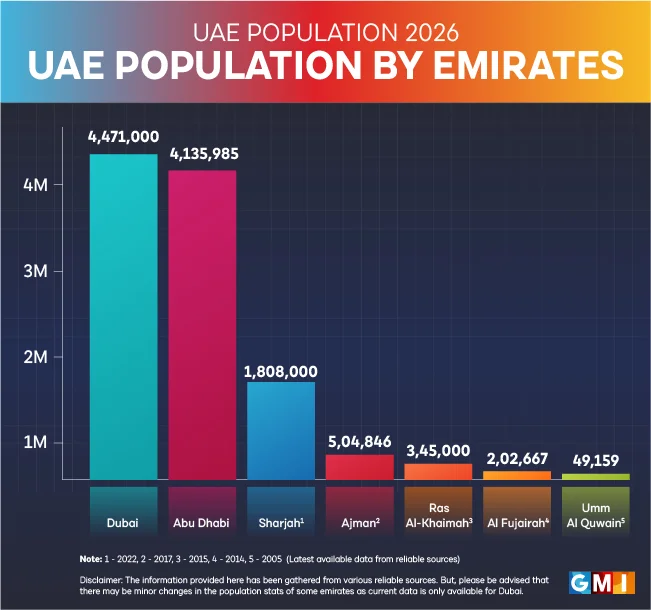
Dubai remains the most populous emirate, with more than 4.47 million residents in 2026. Its position as a global business and tourism hub continues to attract expatriates, entrepreneurs and skilled professionals from across the world.
Abu Dhabi follows with approximately 4.13 million residents, according to the most recent population figures released by the Statistics Centre – Abu Dhabi in 2024.
Sharjah ranks third with about 1.8 million residents, according to the Sharjah Census 2022, which recorded significant population growth in the emirate.
Ajman has an estimated 504,846 residents, based on population statistics reported in 2017. Despite its smaller size, the emirate has experienced steady residential growth due to its proximity to Dubai and Sharjah.
Ras Al Khaimah is estimated to have around 345,000 residents, with the figure derived from official population estimates published in 2015.
Fujairah has a population of roughly 202,667 people, with the most widely referenced population data dating back to 2014.
Umm Al Quwain remains the least populated emirate, with about 49,159 residents, based on the latest recorded population statistics from 2005.
Overall, the distribution of residents across the UAE highlights a strong concentration in Dubai and Abu Dhabi, which together account for the majority of the country’s population due to greater employment opportunities, infrastructure and international connectivity.
UAE Population 2026: Emirati vs Expat
|
Population Type |
Population |
Population Percentage |
|
Emirati Population |
1.33 Million |
11.50% |
|
Expat Population |
10.24 Million |
88.50% |
The UAE population in 2026 remains largely expatriate-driven.
Around 88.50% of residents are expatriates, equivalent to approximately 10.24 million people.
This makes the UAE one of the most internationally diverse populations in the world.
The Emirati population stands at about 1.33 million, accounting for 11.5% of the total population.
While smaller in proportion, Emirati citizens form the foundation of the country’s governance, culture and long-term development.
A defining feature of the UAE’s demographic structure is that many residents move to the country primarily for employment rather than permanent settlement.
As a result, population trends often reflect economic conditions and labour demand across major sectors.
In recent years, policy initiatives such as long-term residency programmes like the Golden Visa have encouraged skilled professionals to remain in the country for longer periods.
These reforms support talent retention while strengthening the national workforce.
Overall, the UAE’s population structure reflects a balance between a strong expatriate community and a stable national population, helping sustain economic growth and development.
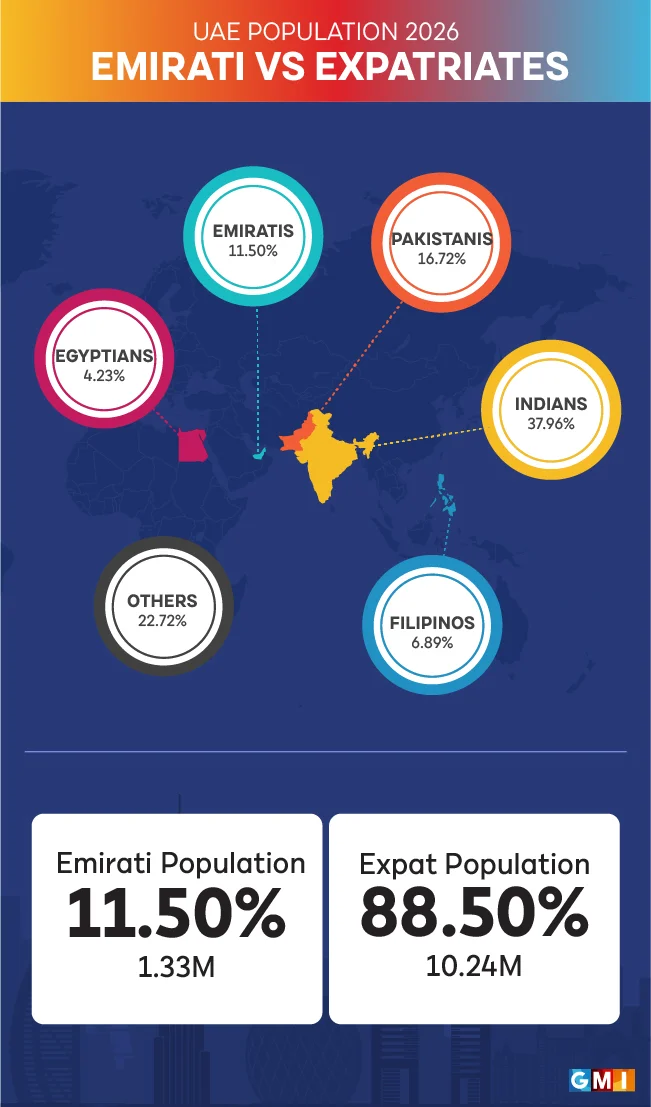
UAE Population by Nationality in 2026
|
Nationality |
Percentage |
Population (in Millions) |
|
India |
37.96% |
4.39 M |
|
Pakistan |
16.72% |
1.94 M |
|
Bangladesh |
7.38% |
0.85 M |
|
Philippines |
6.89% |
0.80 M |
|
Iran |
4.72% |
0.55 M |
|
Egypt |
4.23% |
0.49 M |
|
Nepal |
3.15% |
0.36 M |
|
Sri Lanka |
3.15% |
0.36 M |
|
China |
2.16% |
0.25 M |
|
All other countries |
2.16% |
0.25 M |
Note: The figures are approximate and based on research conducted by the GMI team.
As of 2026, expatriates account for 88.5% of the UAE’s population, representing approximately 10.24 million residents.
The data shows that Indian nationals form the largest expatriate community in the UAE, followed by significant populations from Pakistan and Bangladesh. Communities from the Philippines, Iran and Egypt also represent a substantial share of the country’s expatriate workforce.
Residents from Nepal, Sri Lanka and China contribute to a diverse labour market that spans industries such as construction, healthcare, retail, hospitality and technology.
Overall, the nationality distribution highlights a key feature of the UAE’s demographic structure: the population is strongly influenced by regional migration patterns, particularly from South Asia.
These migration corridors have played a major role in supporting the country’s rapid economic growth and workforce demand.
Indian Population in UAE in 2026
As of 2026, the Indian community remains the largest expatriate group in the UAE, with approximately 4.39 million residents, representing nearly 38% of the country’s total population.
The size of this community reflects the strong economic and social ties between India and the United Arab Emirates.
Over the years, Indian residents have contributed significantly to the UAE’s workforce and business environment.
Indian entrepreneurs are active across sectors such as retail, real estate, logistics, technology, healthcare and professional services.
In recent years, more than 18,000 new Indian companies joined the Dubai Chamber of Commerce, the highest number of registrations among expatriate groups.
Economic cooperation between the two countries has also expanded. Since the implementation of the Comprehensive Economic Partnership Agreement (CEPA), bilateral non-oil trade between India and the UAE has reached around USD 100 billion.
Indian students also form a large share of international university enrolments in Dubai, accounting for over 40% of the international student population in recent academic years.
Overall, the Indian community continues to play an important role in the UAE’s economic activity, business ecosystem and demographic structure.
UAE Population 2026: Urban vs Rural
|
Population Type |
Population |
|
Urban Population |
10.22 M |
|
Rural Population |
1.35 M |
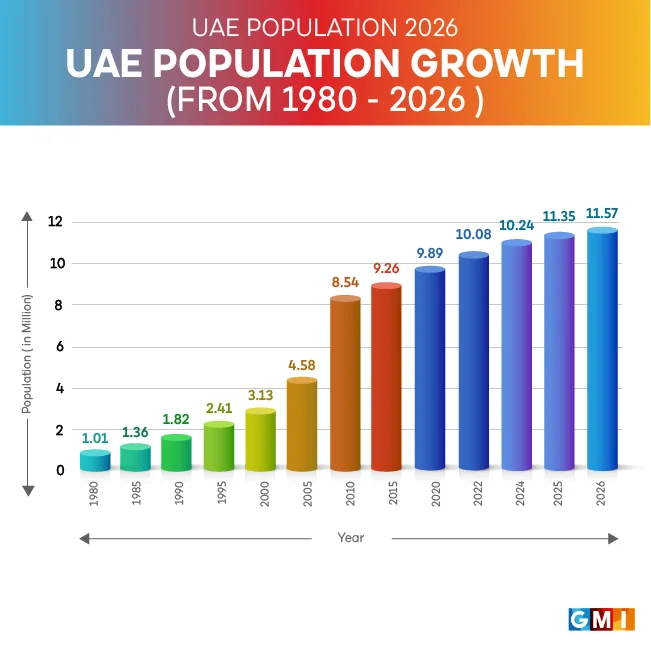
The UAE is a highly urbanised country, with around 10.22 million people (88.3%) living in urban areas, while approximately 1.35 million residents (11.7%) live in rural regions.
This concentration reflects the country’s economic structure, where major cities such as Dubai and Abu Dhabi serve as the primary centres for employment, business and infrastructure development.
These cities continue to attract both expatriates and Emirati residents seeking career opportunities and modern living environments.
Urban areas also offer extensive transport networks, residential developments and commercial districts that support a growing population.
As a result, the majority of residents prefer living in cities rather than rural communities.
Overall, the UAE’s population distribution shows a strong urban concentration, which continues to influence national planning in areas such as housing, transport and infrastructure development.
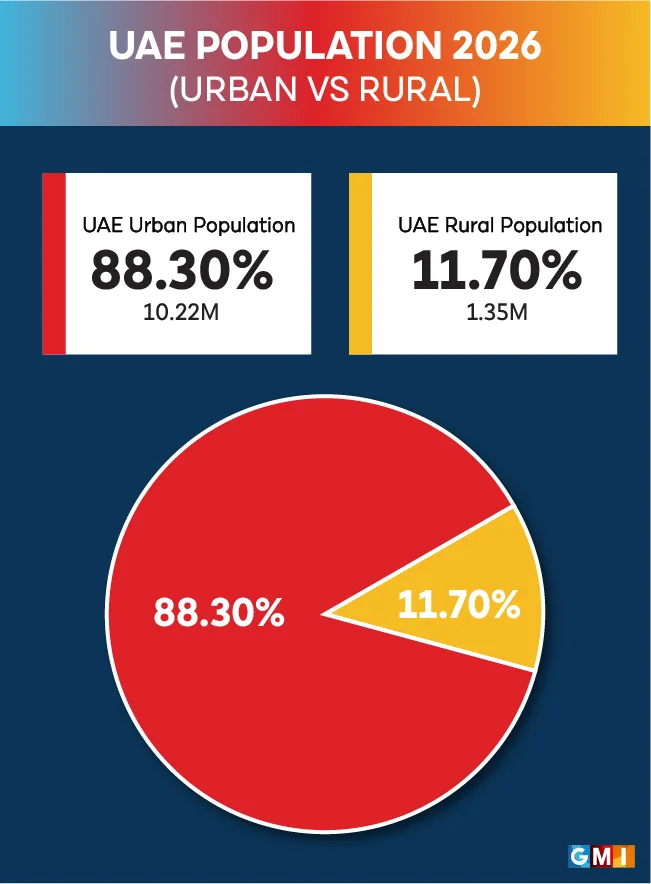
UAE Population Growth From 1985 to 2026
|
Year |
Population (in Million) |
|
2026 |
11.57 |
|
2025 |
11.35 |
|
2024 |
10.24 |
|
2022 |
10.08 |
|
2020 |
9.89 |
|
2015 |
9.26 |
|
2010 |
8.54 |
|
2005 |
4.58 |
|
2000 |
3.13 |
|
1995 |
2.41 |
|
1990 |
1.82 |
|
1985 |
1.36 |
The UAE’s population has grown rapidly over the past four decades, reflecting the country’s transformation into a global economic hub.
During the 1980s and 1990s, steady population growth accompanied early infrastructure development and expanding oil revenues.
As the country invested in modern cities and industries, migration increased gradually.
Growth accelerated during the 2000s, driven by large-scale construction projects, expanding free zones and rising international business activity.
This period marked a major shift as the UAE attracted a growing expatriate workforce.
In the 2010s, continued urban expansion, tourism development and new economic sectors supported further population growth.
Despite global disruptions around 2020, the UAE maintained a stable demographic trend.
By 2026, the population is estimated to reach 11.57 million, highlighting the country’s sustained economic growth and its continued appeal as a destination for professionals, entrepreneurs and investors.
Overall, the UAE’s population growth closely reflects its economic expansion, labour demand and international connectivity.
Why Population Statistics Matter for Marketing in the UAE
Population data plays an important role in shaping effective marketing strategies in the UAE.
For businesses and digital marketing teams, demographic insights help guide decisions on audience targeting, budget allocation and platform selection.
The UAE has one of the most diverse populations in the world, with expatriates making up nearly 90% of residents.
This diversity requires brands to design campaigns that resonate with multiple nationalities, languages and cultural backgrounds rather than focusing on a single audience group.
Population statistics also reveal where consumers are concentrated.
With most residents living in major urban centres such as Dubai, Abu Dhabi and Sharjah, businesses can refine their geo-targeting, local SEO and outdoor advertising strategies to focus on high-demand locations.
Age distribution and workforce composition are equally valuable.
A large working-age population drives demand for sectors such as real estate, financial services, education, technology and lifestyle products.
Understanding these trends helps businesses align their marketing with industries experiencing strong demographic demand.
Migration trends also influence market behaviour.
Changes in residency policies, employment patterns and business activity can signal rising demand across sectors such as property, recruitment, retail and hospitality.
Overall, population insights help businesses move from broad targeting to data-driven marketing strategies, enabling brands to reach the communities that actively contribute to the UAE’s economy.
⚠️ Disclaimer & Note: This content is for general informational purposes only. We are not responsible for any errors, financial loss, or damages that may result from its use or reliance. Please verify the information with official sources as needed. Also, please note that population figures may vary slightly as they are updated from multiple sources.
UAE Population 2025 (Infographics)

Demographic Insights of UAE in 2025
Thus far, our 2025 data study has allowed us to categorise the UAE’s demographic data into:
Gender Distribution
|
Gender |
Population |
Percentage |
|
Male |
7.24 Million |
63.80% |
|
Female |
4.11 Million |
36.20% |
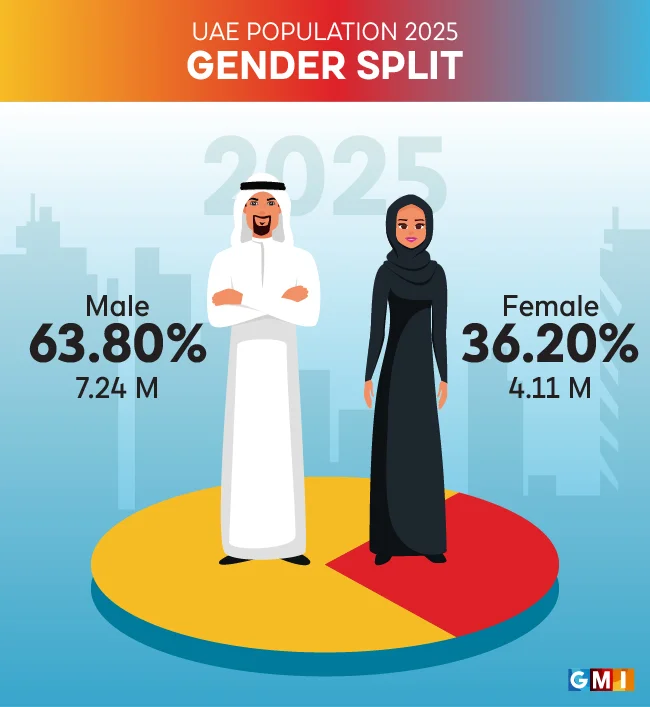
The UAE’s population in 2025 has a noticeable gender imbalance, with males significantly outnumbering females.
Out of the total population, 7.24 million are men, making up a hefty 63.80%.
Meanwhile, 4.11 million are women, accounting for 36.20%.
This gap is largely due to the country’s large expatriate workforce, which consists mainly of male workers in industries like construction, technology, and business.
The trend reflects the UAE’s role as a global hub for employment and economic opportunities, attracting workers from all over the world.
Despite the difference in numbers, both men and women play a crucial role in shaping the UAE’s vibrant society, economy, and culture.
The country continues to evolve, with increasing efforts toward gender balance in the workforce and leadership roles.
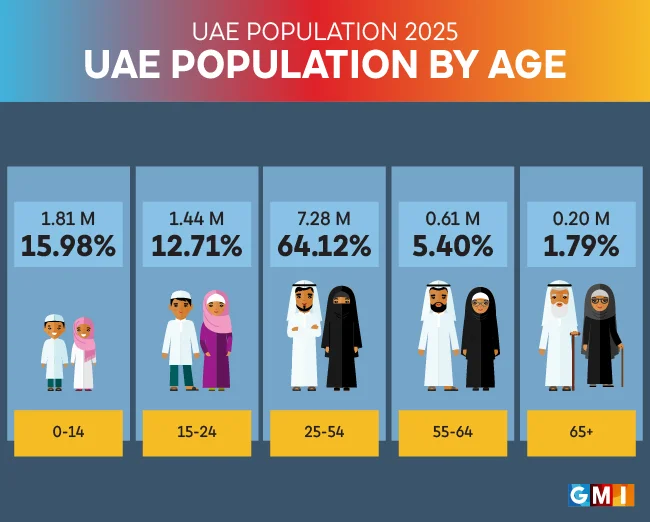
UAE Population by Age
|
Age Group |
Population |
Percentage |
|
0-14 years |
1.81 Million |
15.98% |
|
15-24 years |
1.44 Million |
12.71% |
|
25-54 years |
7.28 Million |
64.12% |
|
55-64 years |
0.61 Million |
5.40% |
|
65 years and over |
0.20 Million |
1.79% |
Did you know that the UAE’s population in 2025 is largely made up of young and middle-aged adults?
Let’s break it down!
Children and teenagers (0-14 years) make up 1.81 million people, accounting for 15.98% of the total population.
Meanwhile, young adults aged 15-24 years contribute another 1.44 million (or 12.71%).
The biggest group by far?
Adults in their prime working years (25-54 years), forming a whopping 7.28 million people, which is 64.12% of the population!
This highlights the UAE’s strong workforce and dynamic economy.
As we move up in age, those between 55-64 years make up 5.40% of the population, or about 0.61 million people.
Finally, seniors aged 65 and over form the smallest group, with 0.20 million individuals, just 1.79% of the total.
Overall, the UAE has a youthful and active demographic, with a majority of its residents in the working-age category.
This is a key factor driving the country’s growth and development!
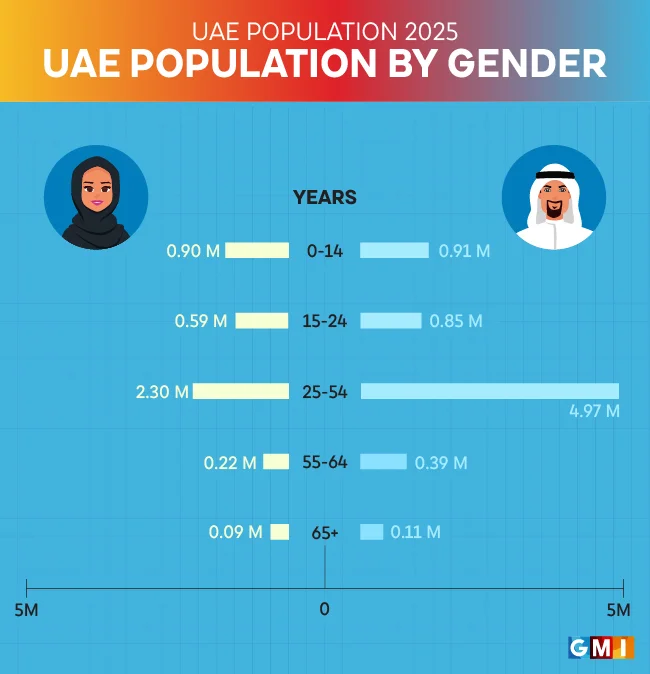
UAE Population by Gender
|
Age Group |
Men Population |
Women Population |
|
0-14 years |
0.91 Million |
0.90 Million |
|
15-24 years |
0.85 Million |
0.59 Million |
|
25-54 years |
4.97 Million |
2.30 Million |
|
55-64 years |
0.39 Million |
0.22 Million |
|
65 years and over |
0.11 Million |
0.09 Million |
In 2025, the UAE’s population is shaped by a clear gender distribution across different age groups.
Let’s dive in!
Among children and teenagers (0-14 years), the numbers are almost equal, with 0.91 million boys and 0.90 million girls, showing a balanced start.
However, as we move to young adults (15-24 years), the gap widens, with 0.85 million men compared to 0.59 million women.
This trend continues into the working-age group (25-54 years), where 4.97 million men far outnumber 2.30 million women—a reflection of the UAE’s large male workforce in key industries.
In the 55-64 age group, the population starts to decline, with 0.39 million men and 0.22 million women.
Finally, in the 65+ category, the numbers are the lowest, with 0.11 million men and 0.09 million women, highlighting a smaller elderly population.
Overall, the UAE’s 2025 demographic structure reveals a significant gender imbalance, particularly in the working-age population, shaped by labor migration and economic opportunities.
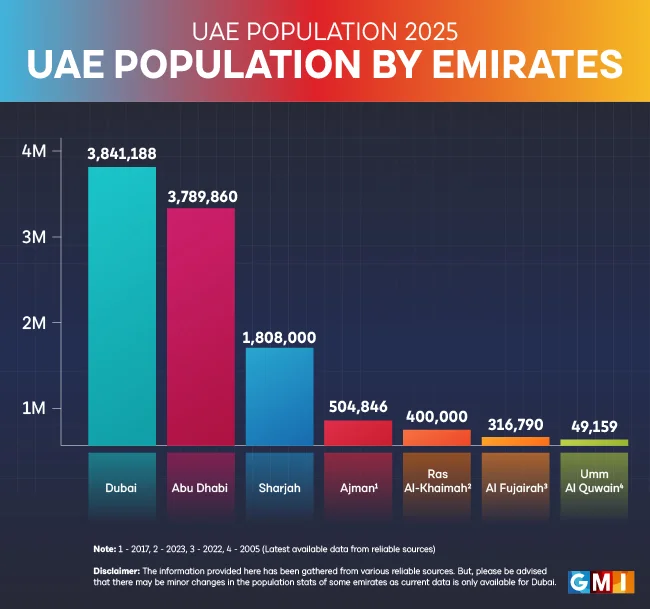
UAE Population by Emirates in 2025
|
Location |
Population |
|
Dubai |
3,943,683 |
|
Abu Dhabi |
3,789,860
|
|
Sharjah
|
1,808,000 |
|
Ajman |
504,846 |
|
Ras al-Khaimah |
400,000 |
|
Fujairah |
316,790 |
|
Umm Al Quwain |
49,159 |
⚠️ Disclaimer: The information provided here is gathered from reliable sources but may change, as most emirates do not have their latest population reports available.
The UAE’s population in 2025 is spread across its seven emirates, with Dubai, Abu Dhabi, and Sharjah leading the way.
Dubai remains the most populated emirate, with 3,943,683 residents, according to the Dubai Statistics Center.
Abu Dhabi follows closely with 3,789,860 people, as per the Abu Dhabi Census 2023.
Sharjah, a growing hub for families and businesses, has a population of 1.8 million.
For the other emirates, the latest available data provides estimates of their populations.
Ajman has around 504,846 residents, based on 2017 data.
Ras Al Khaimah, with a population of 400,000 from 2023 data, continues to grow as a key economic and tourism destination.
Fujairah, home to 316,790 people (based on 2022 figures), plays a vital role in maritime trade.
Meanwhile, Umm Al Quwain, the least populated emirate, had 49,159 residents as per 2005 records, with no recent official updates.
While some population figures are based on older data due to the lack of recent official updates, the UAE’s overall population continues to grow, driven by economic expansion, infrastructure development, and increasing expatriate migration.
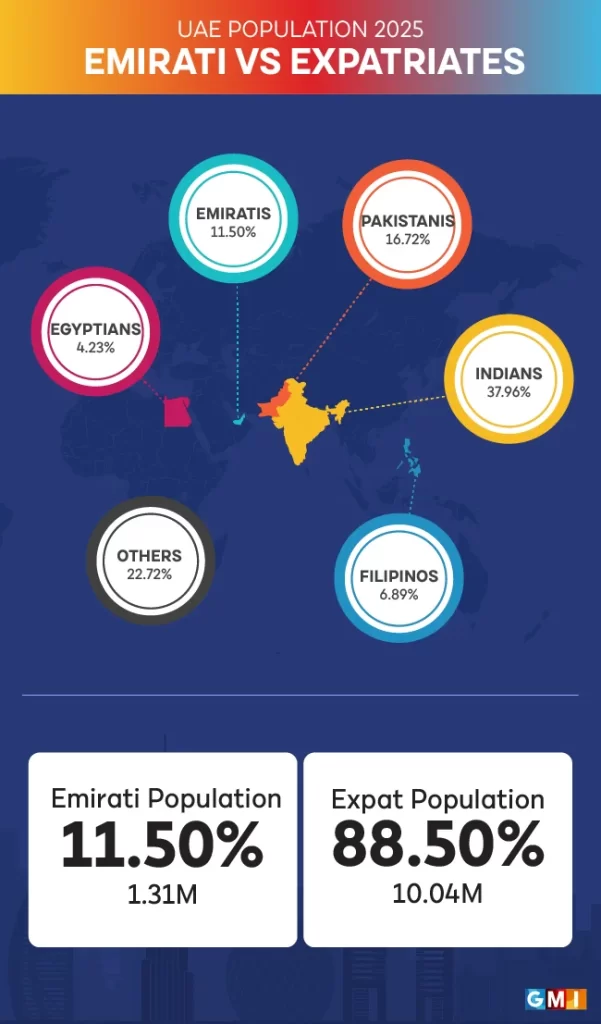
UAE Population 2025: Emirati vs. Expat
|
Nationality |
Population |
Percentage |
|
Emirati |
1.31 Million |
11.50% |
|
Expat |
10.04 Million |
88.50% |
The UAE’s population in 2025 continues to be largely made up of expatriates, who account for a massive 88.5% of the total population.
That’s 10.04 million expats living and working in the country, contributing to its diverse and dynamic society.
Meanwhile, the Emirati population stands at 1.31 million, making up 11.5% of the total.
While a smaller percentage, Emiratis play a crucial role in shaping the country’s culture, leadership, and development.
With the UAE’s reputation as a global business hub, its expat community keeps growing, bringing in talent from all over the world.
At the same time, the government continues to invest in Emirati development, ensuring a balance between national identity and international influence.
UAE Population by Nationality 2025
|
Nationality |
Population |
Percentage |
|
India |
4.36 Million* |
38.45% |
|
Pakistan |
1.90 Million |
16.72% |
|
Bangladesh |
0.84 Million |
7.38% |
|
Philippines |
0.78 Million |
6.89% |
|
Iran |
0.54 Million |
4.72% |
|
Egypt |
0.48 Million |
4.23% |
|
Nepal |
0.36 Million |
3.15% |
|
Sri Lanka |
0.36 Million |
3.15% |
|
China |
0.24 Million |
2.16% |
|
All other countries |
0.19 Million |
1.66% |
📌 Note: *Figure according to a recent statement by the Consul General of India to Dubai and the Northern Emirates, Satish Kumar Sivan.
As of 2025, expatriates make up a significant majority of the UAE’s population, totaling approximately 10.04 million people, which equals 88.5% of the country’s total population.
Among these, Indians form the largest group with 4.36 million residents, accounting for 38.45% of the population.
Pakistanis follow with 1.9 million (16.72%), and Bangladeshis are next with 0.84 million (7.38%).
The Filipino community numbers 0.78 million (6.89%), while Iranians and Egyptians represent 0.54 million (4.72%) and 0.48 million (4.23%) respectively.
Nepalese and Sri Lankans each account for 0.36 million (3.15%).
The Chinese population stands at 0.24 million, contributing 2.16% to the total.
All other nationalities combined add up to 0.19 million, or 1.66%.
This data reflects the UAE’s diverse and international population, with expatriates forming the backbone of the country’s labor force and contributing to its multicultural society.
Indian Population in UAE
As of 2025, the Indian expatriate population in the United Arab Emirates stands at approximately 4.36 million, according to Satish Kumar Sivan, Consul General of India in Dubai and the Northern Emirates.
This figure represents the largest expatriate community in the country, accounting for 38.45% of the total UAE population.
In comparison, the official count in December 2023 was 3.89 million, indicating a significant year-on-year increase.
The Indian community in the UAE is engaged across a wide range of sectors, including construction, healthcare, information technology, education, and retail.
Over the years, they have played a crucial role in supporting the nation’s infrastructure and service industries.
Beyond their economic contributions, the Indian diaspora has established a strong social and cultural presence in the UAE.
The community has founded numerous educational institutions, cultural organizations, religious centers, and small to medium-sized enterprises, reflecting their deep-rooted presence in the region.
This steady growth not only highlights the enduring relationship between India and the UAE but also underscores the vital role the Indian community continues to play in the country’s economic development and multicultural identity.
UAE Population 2025 (Urban vs Rural)
|
Urban |
10.00 Million |
88.10% |
|
Rural |
1.35 Million |
11.90% |
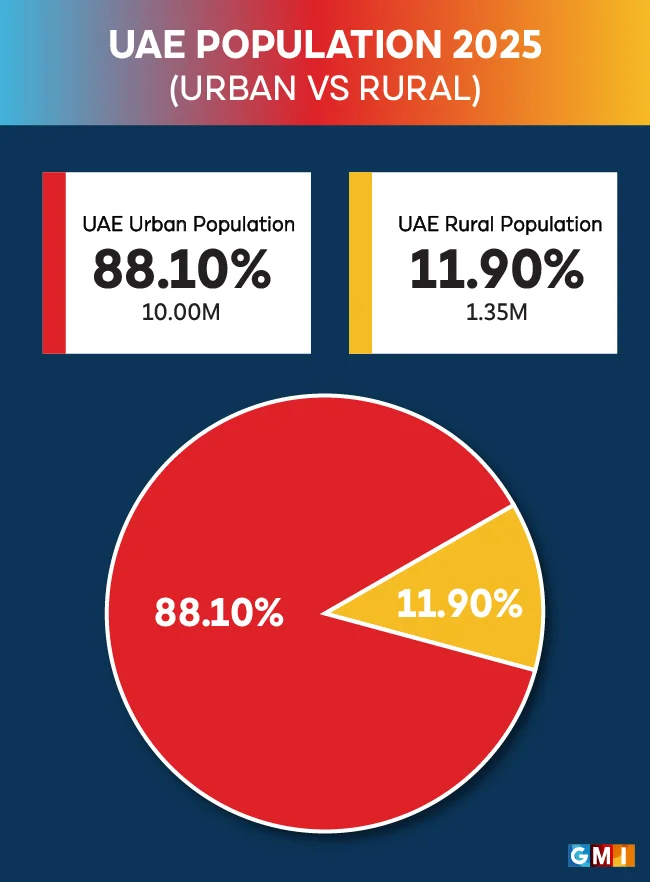
The UAE is an urban powerhouse, with the vast majority of its population—10 million people (88.10%)—living in cities.
With world-class infrastructure, towering skyscrapers, and thriving business hubs, it’s no surprise that urban areas dominate the country’s landscape.
On the other hand, 1.35 million people (11.90%) reside in rural areas, where life moves at a slower pace, often centered around agriculture, heritage sites, and traditional Emirati culture.
While smaller in number, these communities play a vital role in preserving the UAE’s rich history and natural beauty.
This contrast between bustling urban centers and tranquil rural landscapes highlights the UAE’s unique balance between rapid modernization and cultural heritage.
UAE Population By Year (1980 – 2025)
|
Year |
Population |
Year % Change |
|
2025 |
11.35 Million |
10.84% |
|
2024 |
10.24 Million |
22.91% |
|
2023 |
10.17 Million |
0.89% |
|
2022 |
10.08 Million |
0.90% |
|
2021 |
9.99 Million |
1.01% |
|
2020 |
9.89 Million |
2.17% |
|
2015 |
9.26 Million |
8.43% |
|
2010 |
8.54 Million |
86.46% |
|
2005 |
4.58 Million |
46.33% |
|
2000 |
3.13 Million |
29.88% |
|
1995 |
2.41 Million |
32.42% |
|
1990 |
1.82 Million |
33.82% |
|
1985 |
1.36 Million |
34.65% |
|
1980 |
1.01 Million |
0% |
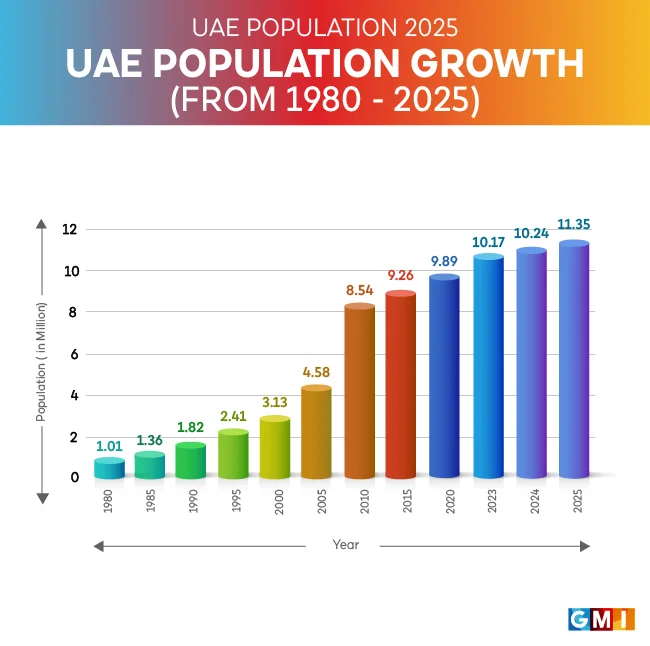
The UAE’s population has grown rapidly over the past few decades, reflecting its transformation into a global hub.
In 1980, the population was just 1.01 million, but as the country developed, more people moved to the UAE for work, business, and a better lifestyle.
By 2005, the population had jumped to 4.58 million, and in just five more years, it nearly doubled to 8.54 million in 2010.
Growth continued steadily, reaching 9.89 million in 2020 and over 10 million by 2023.
Now, in 2025, the UAE’s population stands at 11.35 million, showing how the country continues to attract people from all over the world.
This rise is driven by strong economic opportunities, world-class infrastructure, and a high standard of living, making the UAE a top destination for both residents and businesses.
UAE Population by Religion 2025
|
Religion |
Percentage |
Population (Million) |
|---|---|---|
|
Islam |
74.50% |
8.46 |
|
Christianity |
12.90% |
1.46 |
|
Hinduism |
6.20% |
0.70 |
|
Buddhism |
3.20% |
0.36 |
|
Agnosticism |
1.30% |
0.15 |
|
Other |
1.90% |
0.22 |
Islam is followed by the majority of the population, making up 74.50%, which is about 8.46 million people.
Christianity is next at 12.90%, with around 1.46 million followers.
Hinduism accounts for 6.20% of the population, roughly 0.70 million people.
Buddhism is followed by 3.20%, or about 0.36 million.
Around 1.30% of people — that’s close to 0.15 million — identify as agnostic.
The remaining 1.90%, or approximately 0.22 million, follow other religions that don’t fall into the main categories.
⚠️ Disclaimer & Note: This content is for general informational purposes only. We are not responsible for any errors, financial loss, or damages that may result from its use or reliance. Please verify the information with official sources as needed. Also, please note that population figures may vary slightly as they are updated from multiple sources.
UAE Population 2024 (Key Statistics)
-
As of December 2024, The population of UAE is 12.50 Million, according to the research by GMI Team.
-
The UAE’s population estimate in 2024 has increased to 12.50 million from 10.24 million (which we reported in the Q1 of 2024), is primarily driven by Abu Dhabi’s population official census rise from 1.59 million to 3.78 million.
-
According to the official statistics by the Dubai Government, the Dubai population stands at 3.81 Million as of December 2024.
-
According to the latest Abu Dhabi census, the population of Abu Dhabi stands at 3,789,860 as of 2024.
-
According to the research done by GMI Team, the total Expat population in UAE in 2024 stands at 11.06 Million.
-
The total male population in UAE 2024 is 8.63 Million.
-
The total female population in UAE 2024 is 3.87 Million.
-
The largest age bracket in the UAE’s population falls between 25 to 54 years, making up 8.58 million people.
-
In 2024, the urban population of the UAE stands at 11.00 million, while the rural population constitutes 1.25 million people.
-
The median age of the population in the UAE is 33.6 years.
-
The population density in the UAE (people per sq. km) is 134.5.
UAE Population 2024 (Infographics)
The population of the UAE in 2024 has reached 12.50 million from 10.24 million marking a significant increase.
This growth is largely due to the rise in Abu Dhabi’s population, which has surged from 1.59 million to 3.79 million.
The latest figures released by the Abu Dhabi government census highlight this substantial demographic shift.

Demographics of UAE in 2024
According to our 2024 data study, the demographic data of the UAE can be classified into:
Gender Split
|
Gender |
Population |
Percentage |
|
Male |
8.63 Million |
69.01% |
|
Female |
3.87 Million |
30.99% |
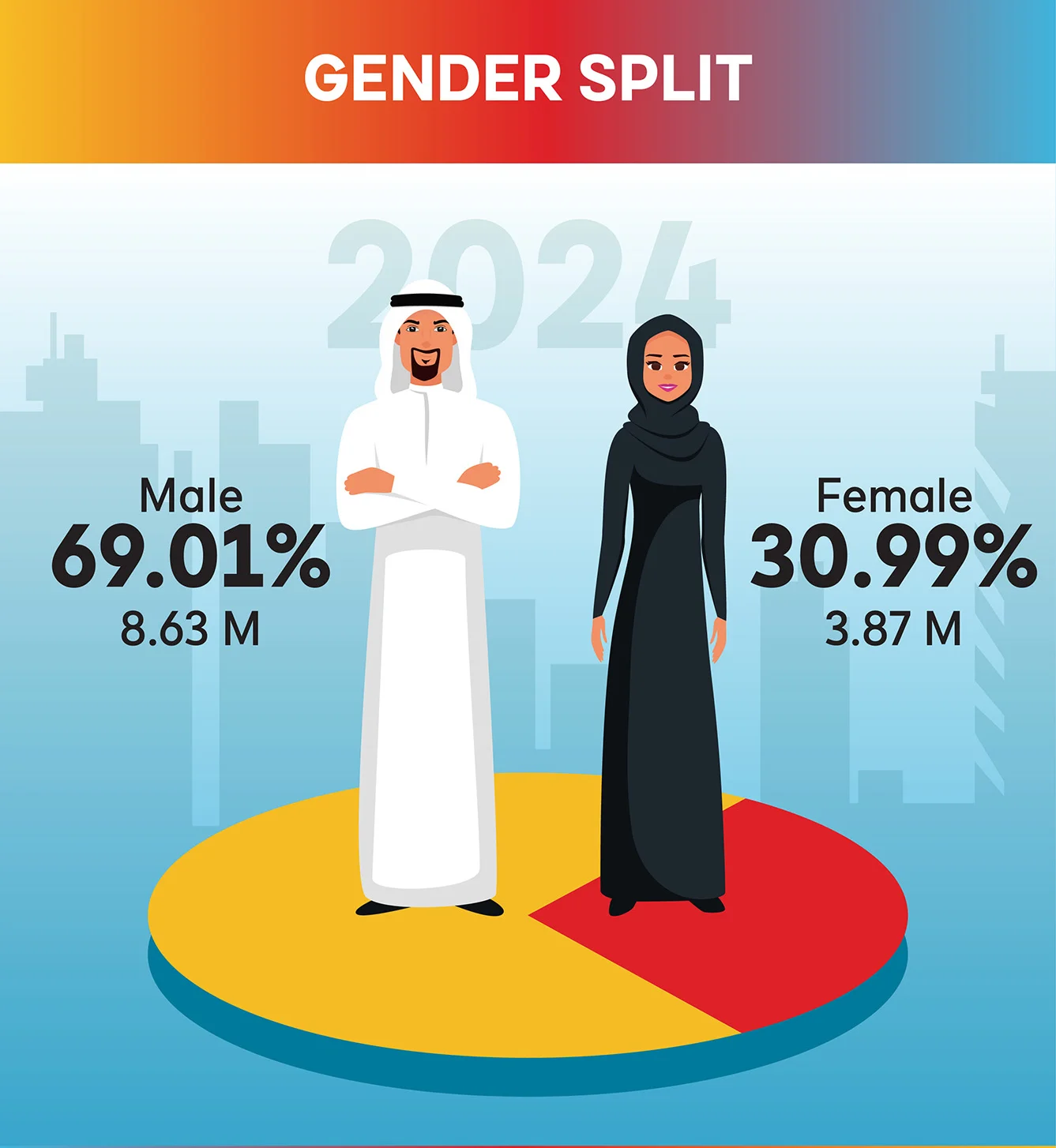
In the UAE’s population breakdown by gender, men make up 8.63 million while women account for 3.87 million.
The gender distribution shown above results from many factors, including family dynamics, education, job scenarios, etc.
However, this balance can shift as society, economics and policy over time.
UAE Population by Age
|
Age Group |
Population |
Percentage |
|
0-14 years |
1.89 Million |
15.12% |
|
15-24 years |
1.14 Million |
9.14% |
|
25-54 years |
8.58 Million |
68.62% |
|
55-64 years |
0.65 Million |
5.21% |
|
65 years and over |
0.24 Million |
1.92% |
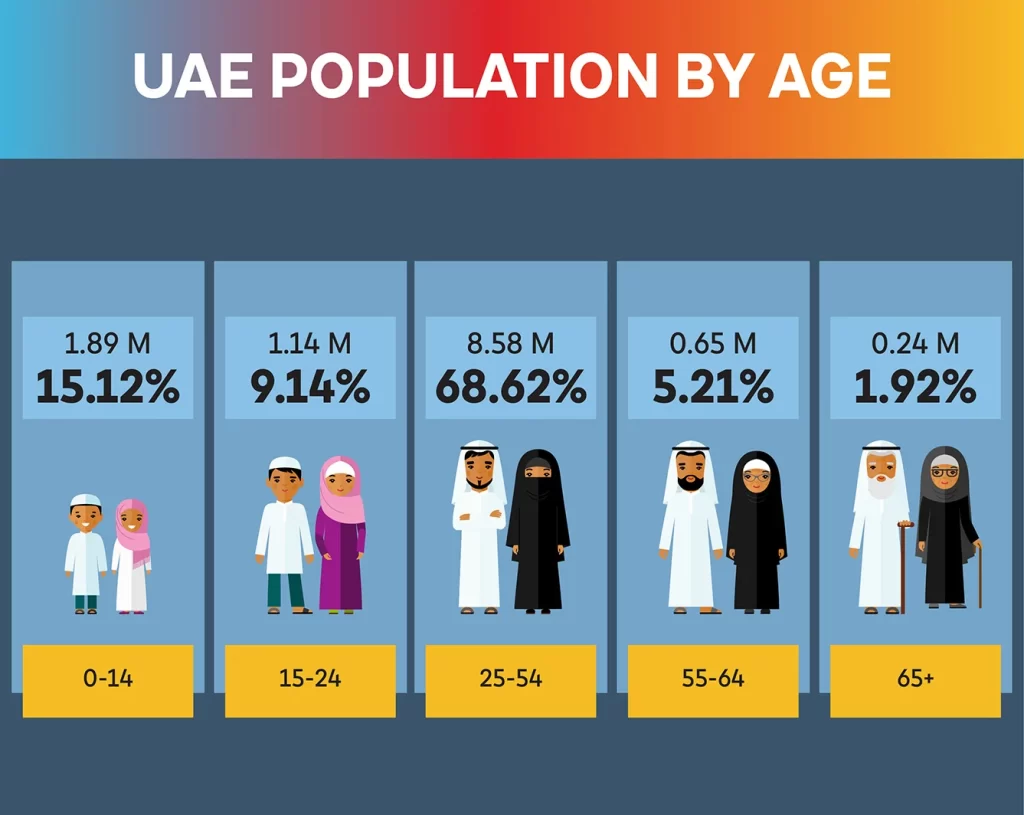
The population distribution across various age groups in the UAE demonstrates a notable concentration within the 25 to 54 years range.
It constitutes the largest portion at 68.62%, equivalent to approximately 8.58 million people.
The younger demographic, aged 0-14 years, accounts for 15.12%, totalling approximately 1.89 million individuals.
The age group of 15-24 years represents 9.14% of the population, comprising about 1.14 million people.
Notably smaller but still significant, the 55-64 years group comprises 5.21% of the population, amounting to approximately 0.65 million individuals.
The older demographic, aged 65 years and over, constitutes 1.92% of the population, totalling around 0.24 million people, reflecting a relatively smaller yet distinct part of the population in the UAE.
The age distribution of the UAE in 2024 clearly shows that the population mainly consists of working-class individuals.
This shows that the UAE is a booming economy with many growth opportunities.
UAE Population by Gender
|
Age Group |
Men Population |
Women Population |
|
0-14 years |
0.98 Million |
0.91 Million |
|
15-24 years |
0.68 Million |
0.46 Million |
|
25-54 years |
6.37 Million |
2.21 Million |
|
55-64 years |
0.47 Million |
0.18 Million |
|
65 years and over |
0.13 Million |
0.11 Million |
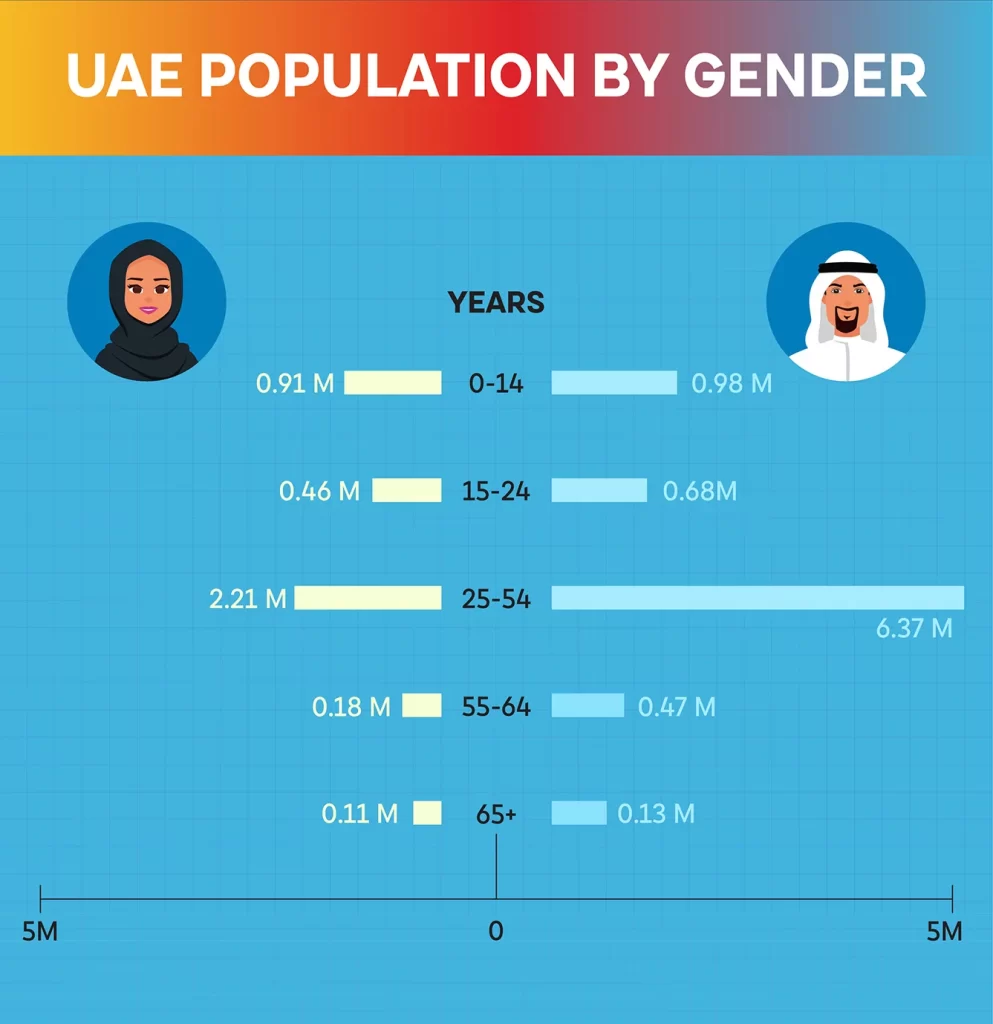
Looking into specific age groups, within the 0-14 year bracket, there are 0.98 million boys and 0.91 million girls.
In the 15-24 years range, the male population is 0.68 million, while females are 0.46 million.
Notably, between 25 and 54 years, the male population is 6.37 million, whereas women in the same age range total 2.21 million.
In the 55-64 years age range, there are 0.47 million men compared to 0.18 million women.
Finally, for individuals aged 65 years and older, men account for 0.13 million, slightly outnumbering women at 0.11 million in this age category.
The gender distribution shown above results from many factors, including family dynamics, education, job scenarios, etc.
However, this balance can shift as society, economics, and policy change over time.
UAE Population by Emirates
|
Location |
Population |
|
Dubai |
3,811,549 |
|
Abu Dhabi |
3,789,860
|
|
Sharjah
|
1,808,000 |
|
Ajman |
504,846 |
|
Ras al-Khaimah |
345,000 |
|
Fujairah |
256,256 |
|
Umm Al Quwain |
49,159 |
Disclaimer: The information provided here is gathered from reliable sources but may change, as most emirates do not have their latest population reports available.
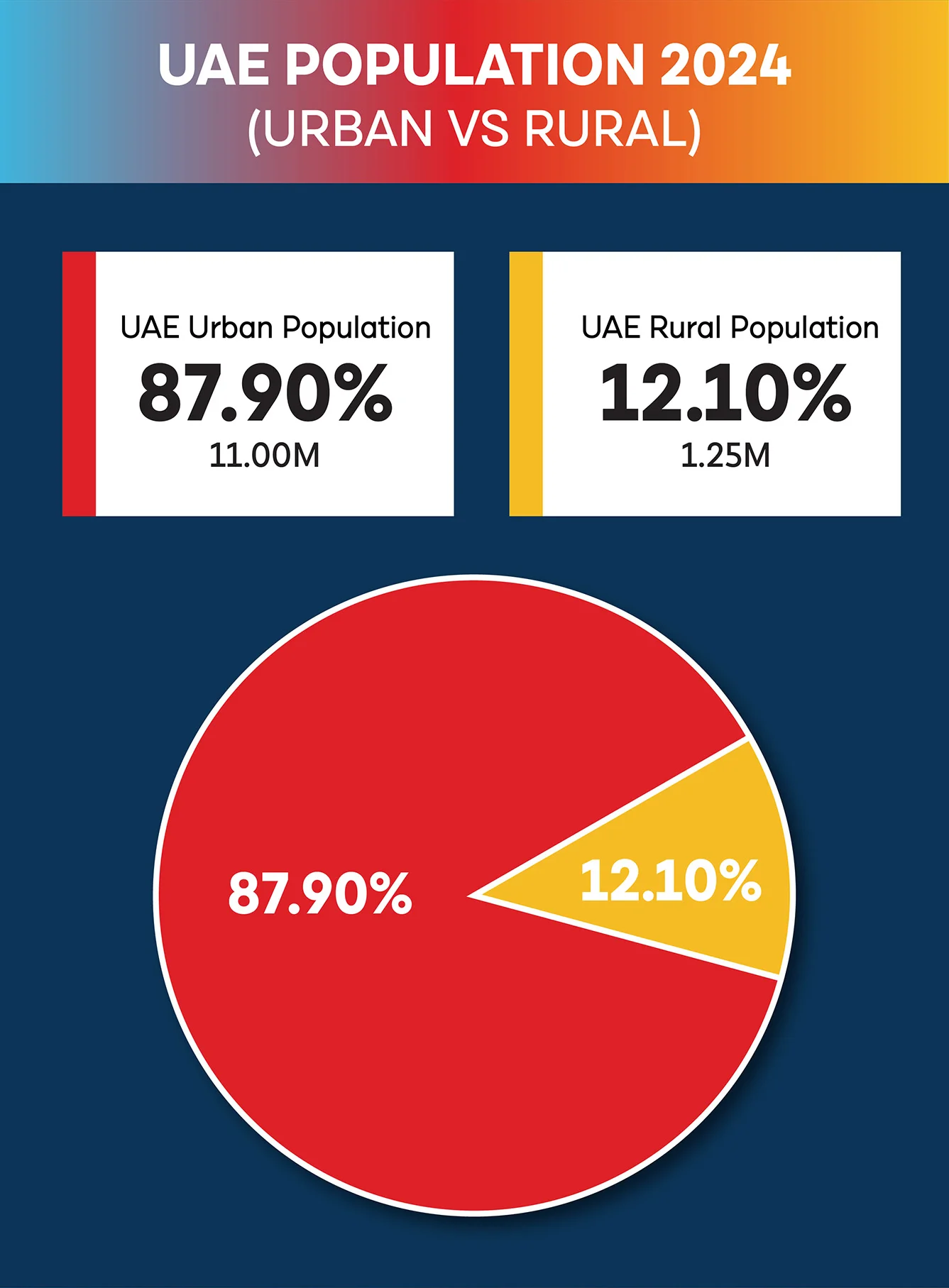
The population distribution among the Emirates in the UAE illustrates a clear dominance of areas such as Dubai, housing 3,811,549 individuals, and Abu Dhabi with 3,789,860 residents.
Sharjah follows closely with a population of 1,808,000, showcasing a considerable concentration of residents as well. For more details, visit the blog onSharjah’s population.
In contrast, the remaining Emirates exhibit smaller population sizes, with Ajman totalling 504,846 inhabitants, and Ras al-Khaimah at 345,000.
Al Fujayrah has 256,256 residents, and Umm al Qaywayn has the smallest population at 49,159.
Various factors like economic opportunities, cultural attractions, and infrastructure development all contribute to the different population sizes among the emirates.
Emirati Vs Expatriates
|
Nationality |
Population |
Percentage |
|
Emirati |
1.44 Million |
11.50% |
|
Expat |
11.06 Million |
88.50% |
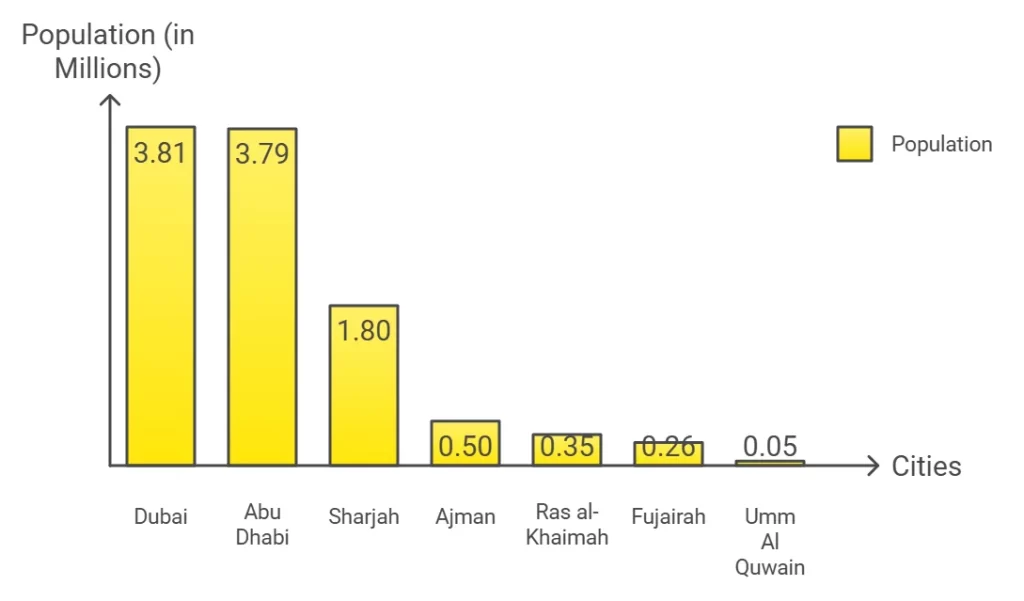
The expat population in the UAE stands at 11.06 million, significantly larger than the Emirati population, which totals 1.44 million.
Expat residents constitute approximately 88.50% of the population, while Emiratis make up around 11.50%.
In the above context, the government is taking steps to help increase the Emirates population.
For example, the Dubai Social Agenda 33 aims to increase the number of Emirati families by 2033.
The agenda also aims to provide more jobs to Emiratis in the private sector.
UAE Population 2024 (Urban vs Rural)
|
Urban |
11.00 Million |
87.90% |
|
Rural |
1.25 Million |
12.10% |
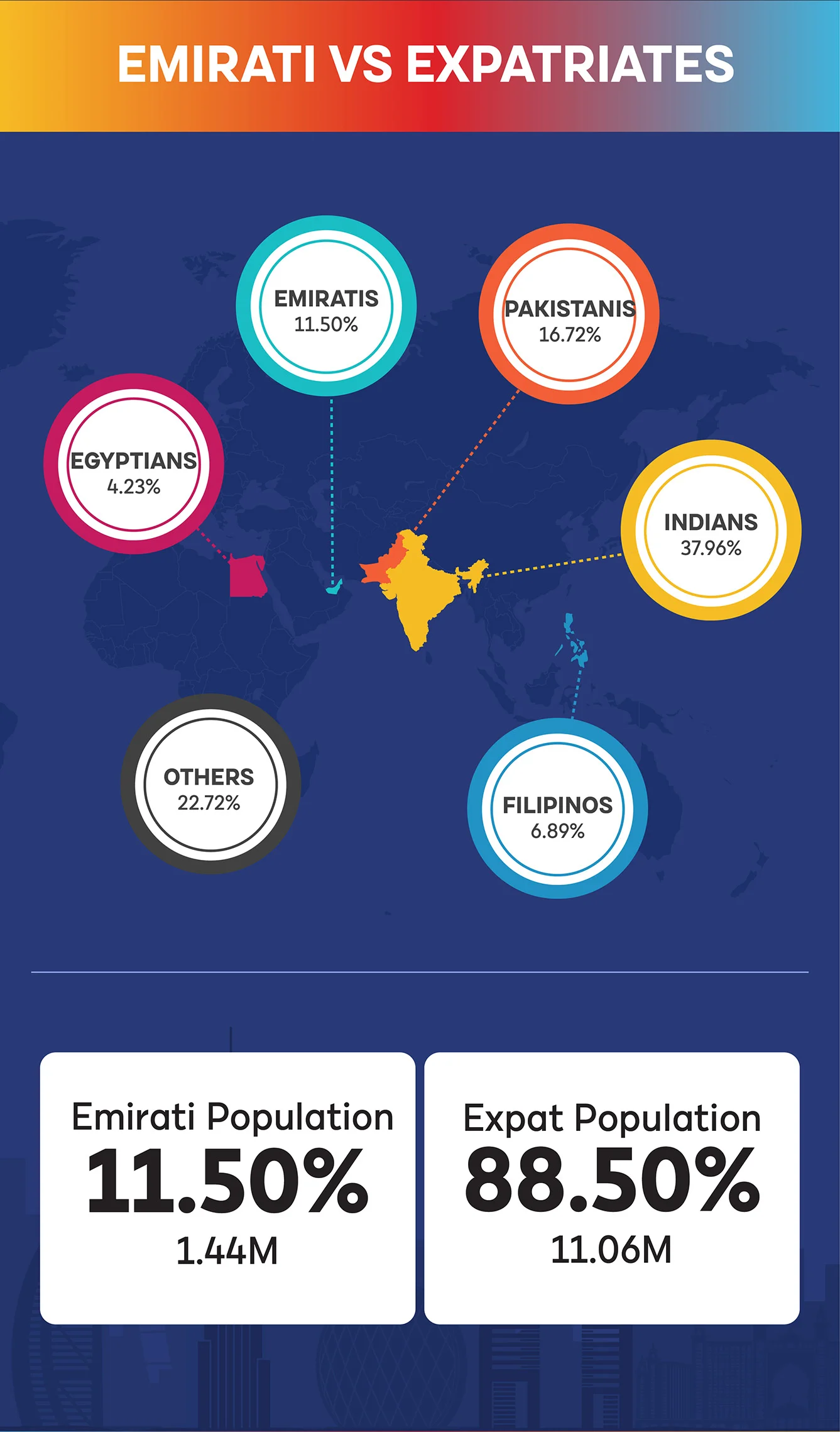
The statistics depict a significant urban-centric demographic in the UAE, with 87.90% (11.00 million) of the population residing in urban areas and only 12.10% (1.25 million) in rural areas.
With improved access to healthcare, education, and job opportunities, people prefer settling in urban areas in 2024.
UAE Population By Year (1980 – 2024)
|
Year |
Population |
Year % Change |
|
2024 |
12.50 Million* |
22.91% |
|
2023 |
10.17 Million |
0.89% |
|
2022 |
10.08 Million |
0.90% |
|
2021 |
9.99 Million |
1.01% |
|
2020 |
9.89 Million |
2.17% |
|
2019 |
9.68 Million |
1.47% |
|
2018 |
9.54 Million |
0.63% |
|
2017 |
9.48 Million |
1.28% |
|
2016 |
9.36 Million |
1.08% |
|
2015 |
9.26 Million |
8.43% |
|
2010 |
8.54 Million |
86.46% |
|
2005 |
4.58 Million |
46.33% |
|
2000 |
3.13 Million |
29.88% |
|
1995 |
2.41 Million |
32.42% |
|
1990 |
1.82 Million |
33.82% |
|
1985 |
1.36 Million |
34.65% |
|
1980 |
1.01 Million |
0% |
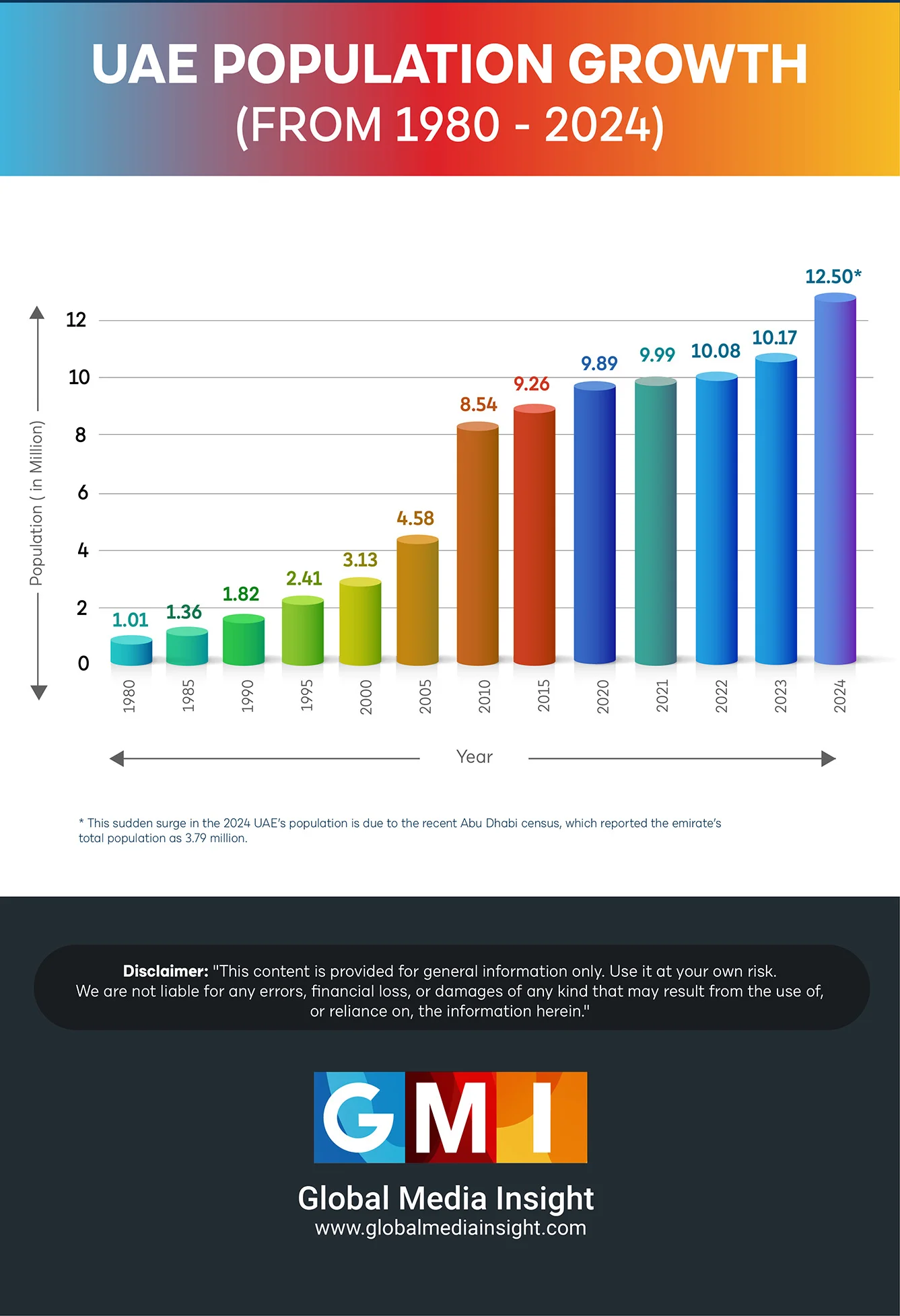
The UAE’s population story is like a journey.
In 1980, there were 1.01 million people.
By 1990, it almost doubled to 1.82 million, thanks to more jobs and a growing economy.
In the 2000s, the population skyrocketed to 4.58 million by 2005.
Big construction projects and a thriving economy brought in lots of people from around the world.
From 2015 to 2024, the population still increased, but not as fast.
At present, it stands at 12.50 million.
Government initiatives focusing on sustainable development and managing population growth have played a role in this shift.
UAE Population by Religion
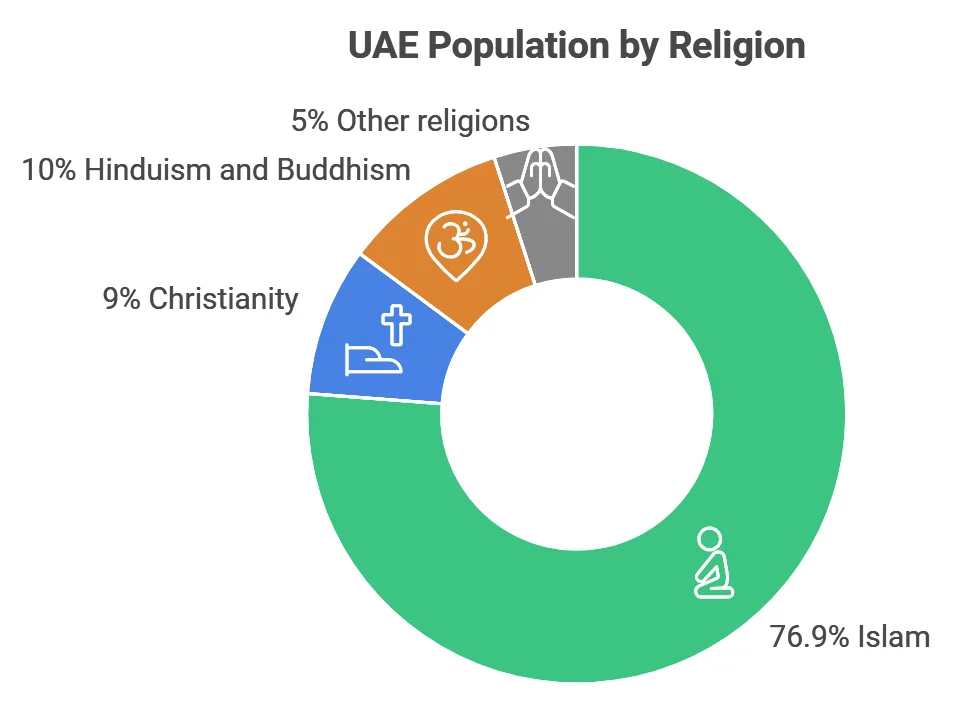
Although Islam is the main religion in UAE with 76.9% of people practising it, we must remember that this country is home to many expats.
So along with Muslims, we can also see Christians(9%), Hindus and Buddhists(10%), and other religions(5%) thriving here.
Literate Population of UAE
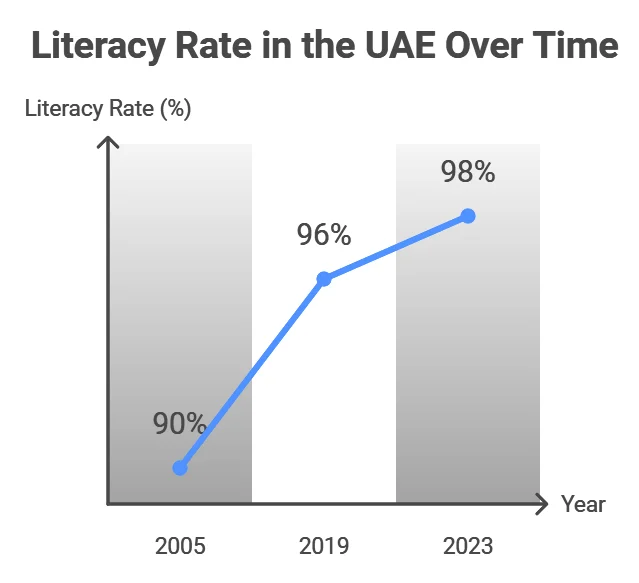
According to the latest data from the World Bank, the UAE’s literacy rate is 98%.
It was 90% in 2005 and 96% in 2019.
That means there has been a consistent growth in the literacy rate in the country thanks to the government’s socio economic policies.
One of the other more obvious reasons is that the UAE is a country of expats.
Because of the employment opportunities it offers, educated people from all over the world come and settle in the UAE.
UAE History
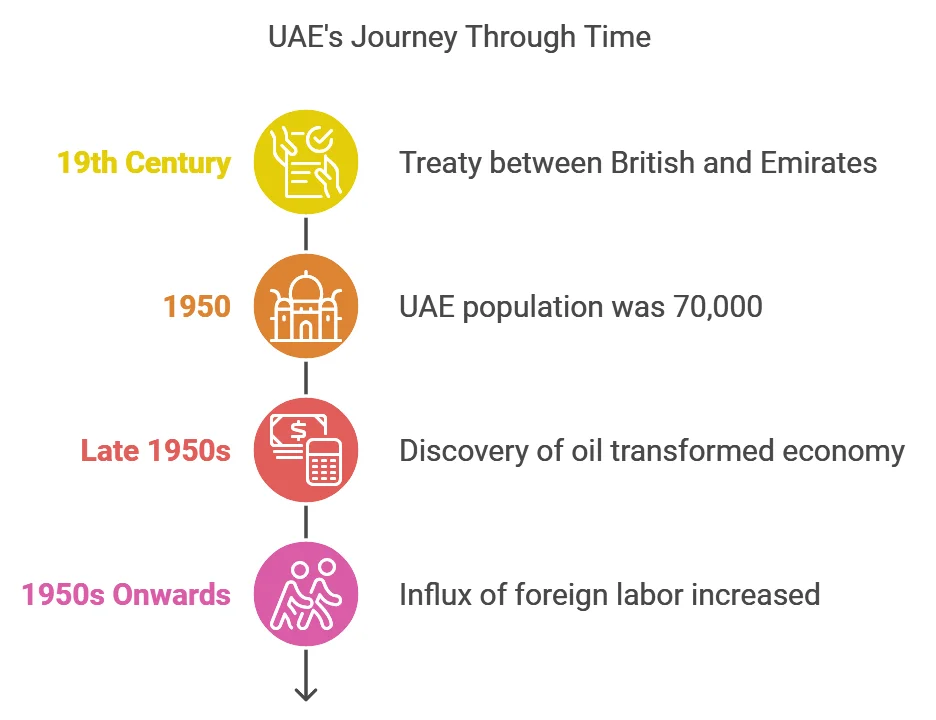
The UAE began its journey from the treaty between the British and the Emirates in the 19th century.
The coalition of the Emirates was called the “Trucial States”.
Once the Trucial State was liberated from the British treaty, the UAE was born.
In 1950, the population of UAE was just 70,000 but with the discovery of oil in the late 1950s a huge economic and social transformation began.
As infrastructural activities began in full swing, the need for foreign labour increased.
Since then, the UAE has seen a huge number of people trickling in to gain from the profitable economic bustle including trade, real estate, construction etc.
Now let us probe into the population statistics and try to understand it clearly.
United Arab Emirates – Country Profile
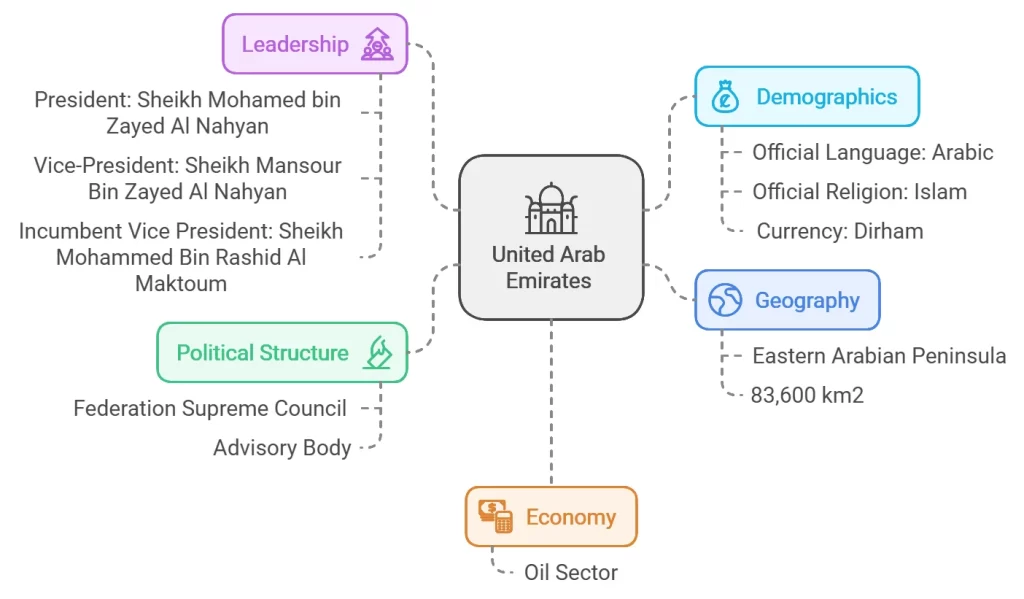
The United Arab Emirates (UAE), formerly the Trucial States, is located at the eastern end of the Arabian Peninsula.
It is a federation of seven emirates: Abu Dhabi (capital), Dubai, Sharjah, Ajman, Umm Al Quwain, Ras Al Khaimah, and Fujairah.
The country spans an area of 83,600 km2 and heavily relies on its oil sector.
The UAE runs as a federation with a single advisory body, The Federation Supreme Council.
At present, the president of the council is Sheikh Mohamed bin Zayed Al Nahyan.
Sheikh Mansour Bin Zayed Al Nahyan has been appointed as the UAE Vice-President with the approval of the UAE Federal Supreme Council.
Concurrently, the incumbent Vice President, Sheikh Mohammed Bin Rashid Al Maktoum, will continue in his current role.
The official language here is Arabic, the official religion is Islam, and the currency used here is the dirham.
Dubai Population in 2024
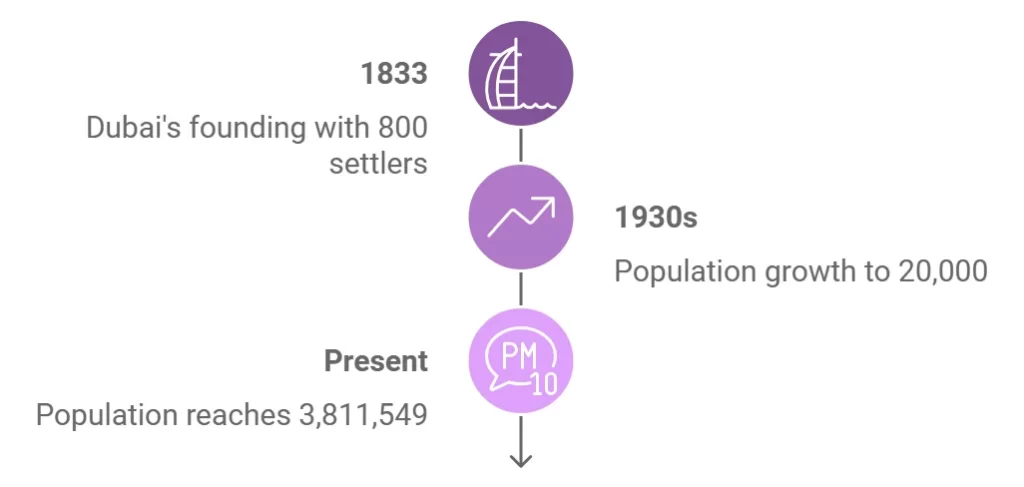
Dubai’s journey began in 1833 with around 800 settlers.
Fast forward to the 1930s, and the population had boomed to almost 20,000, steadily growing since.
Why do people love Dubai?
Well, besides its stunning beauty and welcoming atmosphere, it’s a hotspot for expatriates.
The city’s bustling economy and lots of job opportunities make it a top choice for settling down.
Now, Dubai is racing ahead as one of the fastest-growing cities globally, with a population of 3,811,549.
Dubai has a bustling population, and its unique charm and abundant opportunities continue to attract people from all around the world.
Abu Dhabi Population in 2024
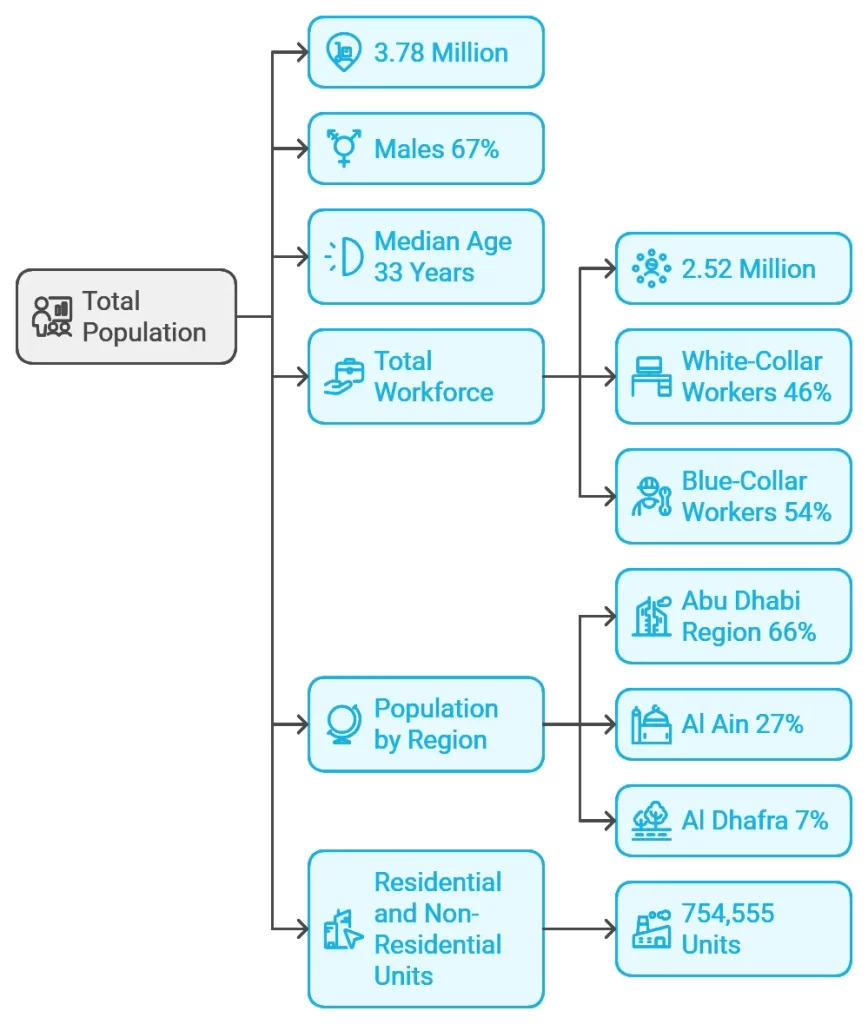
According to the latest Abu Dhabi Emirate Population Census (2023), the total population has reached a staggering 3.78 million.
It also reveals the emirate’s total labour force as 2.52 million.
The census also reveals the emirate’s total labor force as 2.52 million, highlighting significant demographic changes and the dynamic expansion of Abu Dhabi’s workforce.
Here is a detailed analysis of the Emirate’s population:
-
Abu Dhabi’s population increased by 83% since 2011, reaching 3,789,860 people last year.
-
Males constitute 67% of the population, which means there are twice as many males as females.
-
The median age of Abu Dhabi’s population is 33 years.
-
The UAE’s population is concentrated in the Abu Dhabi region, where 2,495,925 people reside, making up 66% of the total. Al Ain comes in second with a population of 1,009,735 (27%), while Al Dhafra is home to 284,205 residents (7%).
-
There was an 82% increase in the employed population since 2011, with the total employment reaching 2,522,390 individuals.
-
The total Abu Dhabi workforce comprises white-collar workers who make up 46% of the employed population (which saw a 109% increase since 2011) and blue-collar workers who make up the rest of the 54% of the employed population (which saw a 65% increase since 2011).
-
The number of residential and non-residential units increased by 66% since 2011, totalling 754,555 units, with 441,410 being residential (58%) and 313,145 non-residential (42%).
UAE Population 2023 (Key Statistics)
-
As of December 2023, the population of UAE is 10.17 Million, a 0.89% increase from 2022, according to the research by GMI Team.
-
The population density of the UAE stands at 121.59 person Km2, with most of the population residing in Abu Dhabi and Dubai.
-
According to the research done by GMI, the total Expat population in UAE in 2023 stands at 9.0 Million.
-
In 2023, the UAE’s urban population is 8.91 million, and the rural population is 1.26 million.
UAE Population 2023 (Infographics)

Demographics of UAE in 2023
Based on our data study, the demographic data of the UAE in 2023 can be classified into:
Gender Split
|
Gender |
Population |
Percentage |
|
Male |
6.97 Million |
68.58% |
|
Female |
3.20 Million |
31.42% |
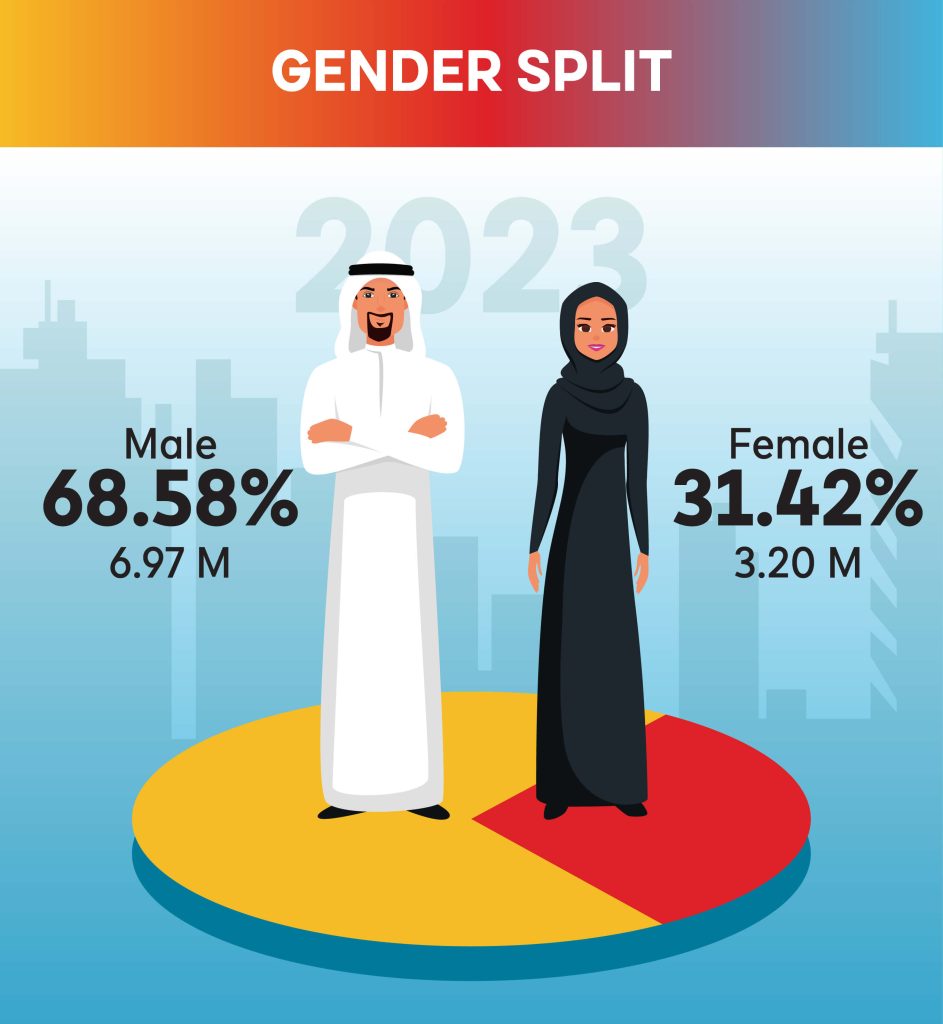
In 2023, the gender split in the UAE continues to show a wide margin. Out of the total population of 10.17 million people, the male population makes up 68.58% i.e. 6.97 million and the female population stands at a total of 3.2 million, making up only 31.42% of the population.
This difference could be attributed to the increasing number of male expatriates in the nation’s workforce, as most of the available jobs for immigrants are dependent on male labour.
Life expectancy along with certain societal and cultural factors also influence roles and opportunities provided to each gender which has resulted in gender disparity.
A point to remember here is that these figures can vary based on region and age group.
UAE Population by Age
|
Age Group |
Population |
Percentage |
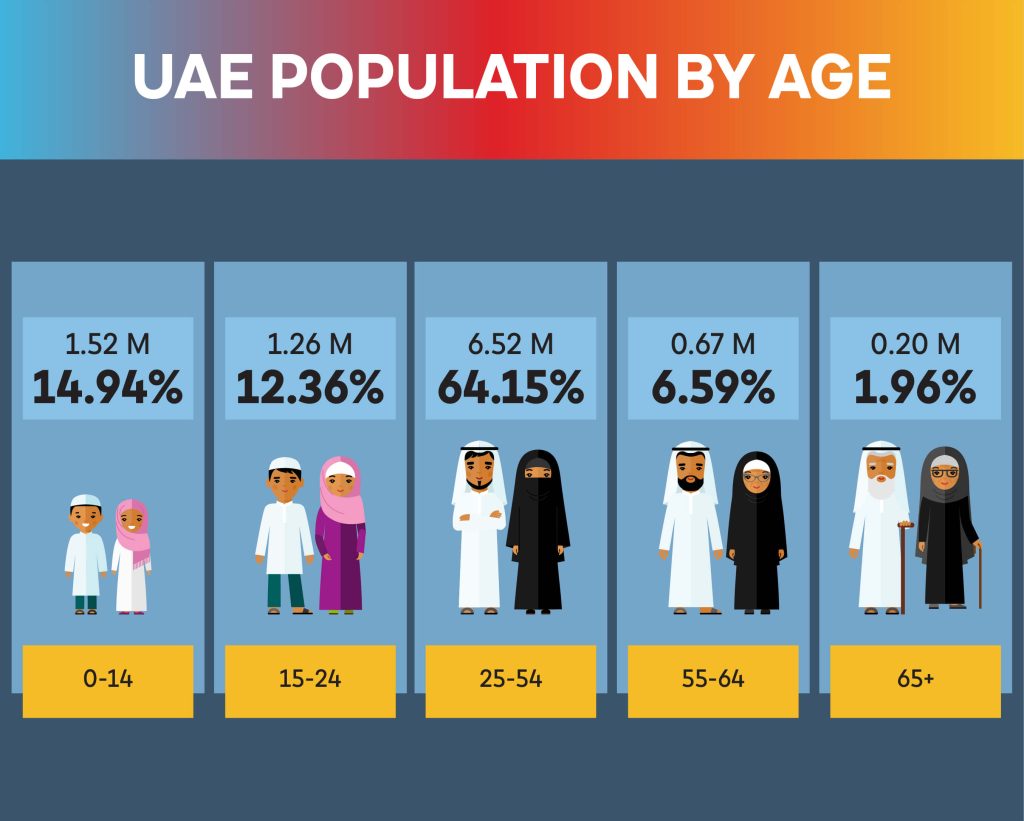
|
0-14 years |
1.52 Million |
14.94% |
|
15-24 years |
1.26 Million |
12.36% |
|
25-54 years |
6.52 Million |
64.15% |
|
55-64 years |
0.67 Million |
6.59% |
|
65 years and over |
0.20 Million |
1.96% |
Our research shows that the death rate is extremely low, and the birth rate in the UAE is at a moderate level in 2023.
People are beginning to live longer, and the population size is increasing. This indicates a well-developed healthcare system contributing to longer life expectancy.
The immigrant population (age 25–54 years) is the highest, amounting to 6.52 million people which is significantly higher than other age groups.
UAE Population by Gender
|
Age Group |
Men Population |
Women Population |
|
0-14 years |
0.77 Million |
0.75 Million |
|
15-24 years |
0.79 Million |
0.47 Million |
|
25-54 years |
4.77 Million |
1.75 Million |
|
55-64 years |
0.50 Million |
0.17 Million |
|
65 years and over |
0.14 Million |
0.06 Million |
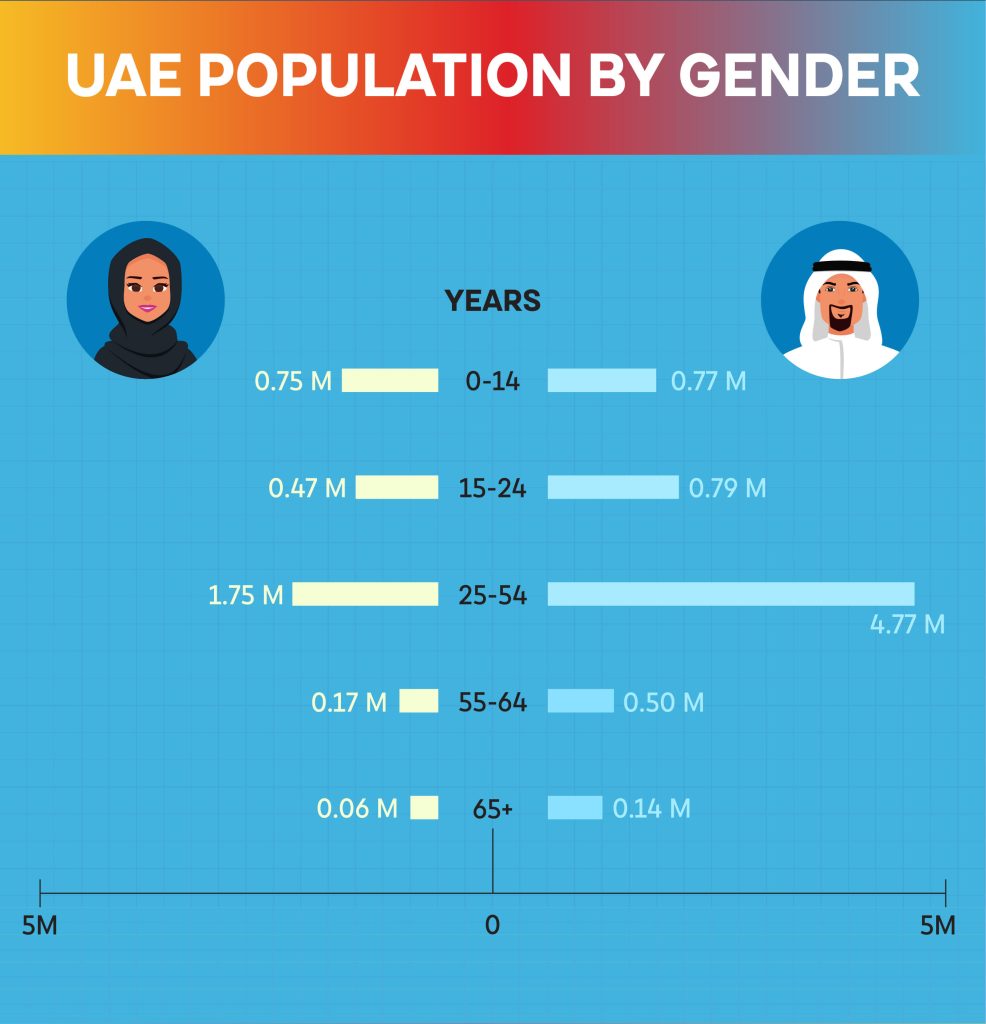
With references to the previous statistics on gender split and age, we can analyze gender distribution in the UAE based on different age groups.
Here also we can see that the highest population of both males and females is between the ages of 25 and 54. The male population stands at 4.77 million, and the female population is at 1.75 million, showing a wide margin in gender split.
The older population of 65 years and above shows a much lower rate. The male population stands at 0.14 million, and the female population is at 0.06 million.
This indicates how the margin of difference between the male and female population is not just confined to the working age group but by small margins exists in every category.
UAE Population by Emirates
|
Location |
Population |
|
Dubai |
3,646,010 |
|
Sharjah |
1,831,000 |
|
Abu Dhabi |
1,567,000 |
|
Ajman |
504,846 |
|
Ras al-Khaimah |
345,000 |
|
Fujairah |
256,256 |
|
Umm Al Quwain |
49,159 |
Due to its popularity as a migration destination for Expats worldwide, Dubai has the biggest population among the seven emirates, at over 3,646,010.
Sharjah, with a population of 1,831,000, is the next largest city. The population of Abu Dhabi is 1,567,000 while that of Ajman is 504,846.
Ras al-Khaimah has 345,000 people while Fujairah has 256,256 people. Umm Al Quwain, home to 49,159 people, is the least populated Emirate.
Emirati Vs Expatriates
|
Nationality |
Population |
Percentage |
|
Emirati |
1.17 Million |
11.48% |
|
Expat |
9.0 Million |
88.52% |
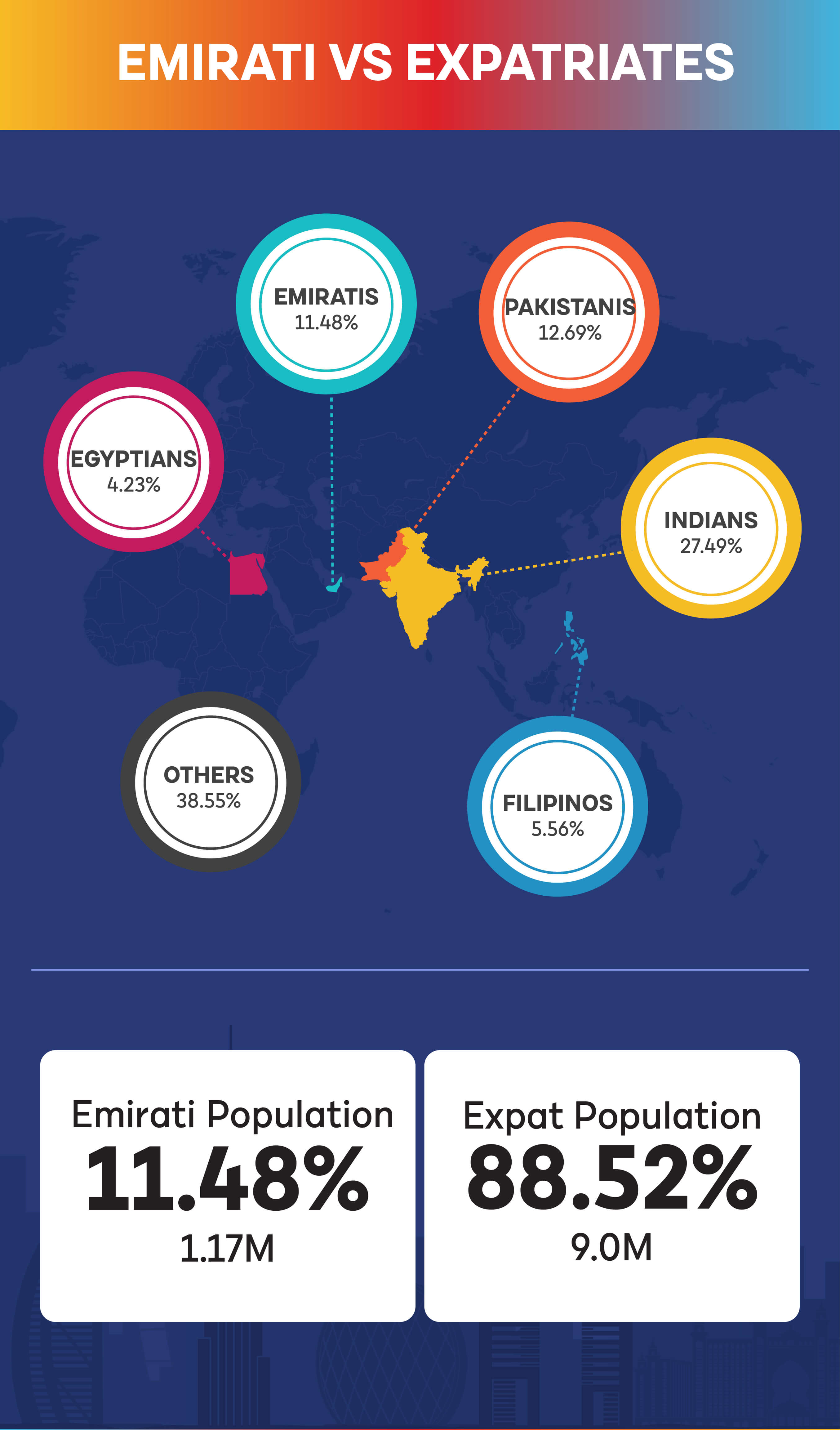
The availability of job opportunities, lack of income tax, high standard of living, and other attributes make the UAE a prime destination for immigrants.
In the Expat Essential Index, the UAE stands in second place behind Bahrain.
The expat population totals around 88.52%, i.e., 9.0 million, while the nationals only amount to 11.48%, i.e., 1.17 million.
As the citizens of UAE become a minority, in 2023, the UAE cabinet seeks to bring more job opportunities for natives in all economic sectors.
UAE Population 2023 (Urban vs Rural)
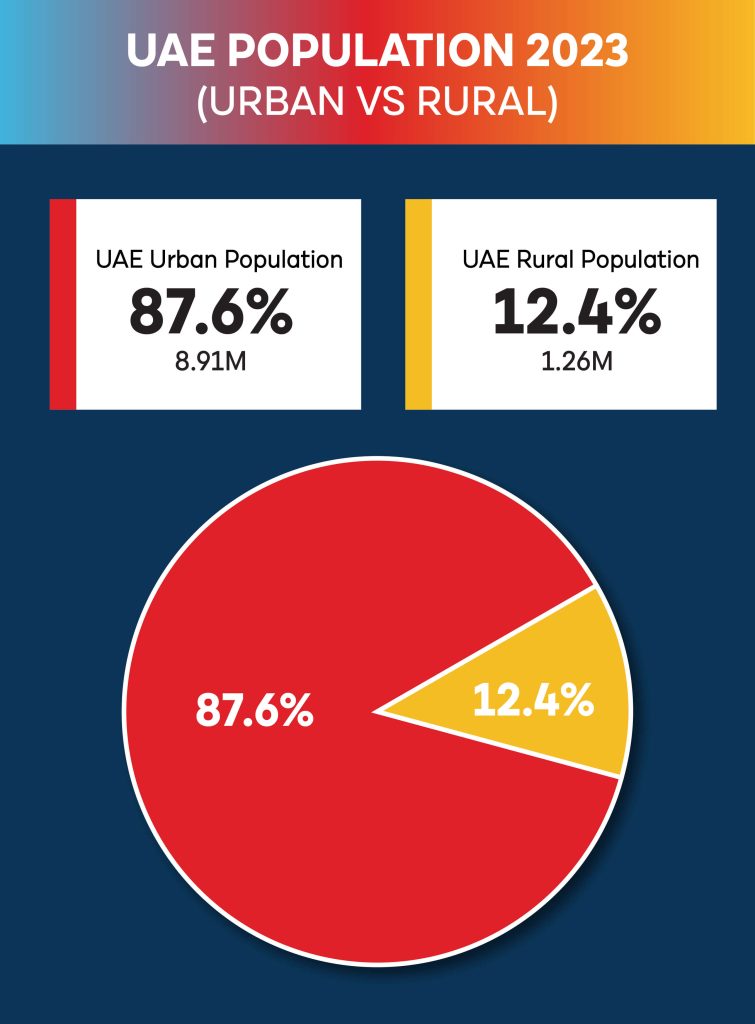
Our UAE population data study shows that the UAE has been experiencing urbanization trends for quite some time.
In 2023, the urban population reached 8.91 million, accounting for 87.6% of the total population, a slight increase from 2022.
In contrast, the rural population in 2023 stands at 1.26 million, constituting 12.4% of the total population, a slight decrease from 2022.
This shift towards urbanization may be attributed to an increasing number of people migrating to cities in search of job opportunities and better living conditions.
UAE Population By Year (1980 – 2023)
|
Year |
Population |
Year % Change |
|
2023 |
10.17 Million |
0.89% |
|
2022 |
10.08 Million |
0.90% |
|
2021 |
9.99 Million |
1.01% |
|
2020 |
9.89 Million |
2.17% |
|
2019 |
9.68 Million |
1.47% |
|
2018 |
9.54 Million |
0.63% |
|
2017 |
9.48 Million |
1.28% |
|
2016 |
9.36 Million |
1.08% |
|
2015 |
9.26 Million |
8.43% |
|
2010 |
8.54 Million |
86.46% |
|
2005 |
4.58 Million |
46.33% |
|
2000 |
3.13 Million |
29.88% |
|
1995 |
2.41 Million |
32.42% |
|
1990 |
1.82 Million |
33.82% |
|
1985 |
1.36 Million |
34.65% |
|
1980 |
1.01 Million |
0% |
Dubai Population in 2023
Dubai is the first choice for immigrants considering the growing economy and diverse opportunities. It has a rich culture, natural beauty and is the business hub of the Middle East.
Therefore as mentioned above it is the most populated Emirate in the UAE. As of December 2023, the population of Dubai stands at 3,646,010.
The population density of the city is approximately 762.6 individuals per square meter. Dubai is the second largest Emirate with an area of 4,114 square kilometres.
Being a cosmopolitan city, the city has seen the growth of many religions including Christians, Sikhs and Hindus.
Dubai Population Growth
In 1980 the population of Dubai was around 0.27 million. This increased to 0.68 million in 1995 and 1.3 million in 2005.
In 2015, it crossed the two million mark to reach 2.38 million and by 2018 it again added 1 million to its population. The population growth rate is predicted to be 10.7% annually.
Just like the rest of the emirates, the gender division is skewed here. There are 7,118,367 million males and 3,128,568 million females.
There are several factors for the high population growth rate in Dubai, the most important of them all is the cosmopolitan approach.
Due to this many foreign nationals have settled in the region increasing the expatriate population. In 30 years, the population has grown by millions.
The Dubai Expo 2020 has created almost 2,70,000 additional job opportunities. With the huge influx of workers, Dubai’s population will hit an all-time high in 2030.
Population Forecasts/Predictions
According to reports, the population boom of the UAE is supposed to reach its full peak in 2033 at 10.71 million people.
There is a net increase of 1 person every minute.
Researchers claim that once the peak is reached, the population will then decline very slowly and by the end of the 21st century, the total population will be 9.03 million people.
The growth rate of 1.47% is expected to decrease to 0.68% in 2025.
These same sets of projections state the population of the United Arab Emirates will be 11,054,579 in 2030, 12,207,333 in 2040 and 13,163,548 in 2050.
*Note: These population estimates have utilized the data from World Population Prospects(UN).
The steady growth of the population in the UAE indicates that the economy is well-developed to nourish and sustain the influx of people looking to live here.
With an interesting mix of nationalities, UAE has emerged as a global power with tremendous reach in 2023.
An in-depth analysis of the population of the UAE can help marketers formulate plans, goals and strategies to promote their brand. With more than 24 years of experience in the digital landscape of the Middle East, GMI has crafted the digital presence of some of the best brands in the region. We understand what it takes to tap into your target audience on various digital platforms. We can help ideate and weave a digital strategy that works for your brand. Talk to our digital strategists today and take your brand to the people you want to reach.
Disclaimer: GMI acknowledges that though we try to report accurately, we cannot verify the absolute facts of everything that has been represented on this infographic. The information represented is based on information researched from various sources on the internet. We are not liable for any errors, financial loss, or damages of any kind that may result from the use of, or reliance on, the information herein.